670-61-16-63 cmd@cristalljoia.com In the heart of Barcelona and online
Shopping Cart

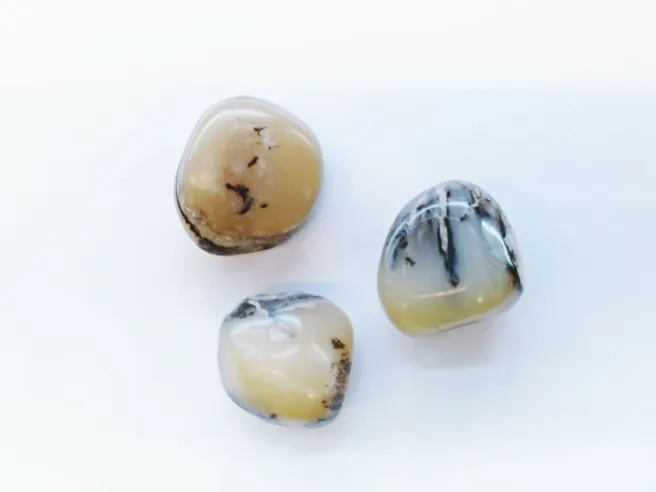
Dendritic opal tumbled stone
Last items in stock
€3.00
Dendritic opal tumbled stone
With its branch-like inclusions, it is the tree of life in miniature. Cristalljoia, 40 years of minerals, find us in the center of Barcelona and online.
Dendritic opal tumbled stone
Opal is often a fossilizing element for plants and animals.
Approximate sizes of the tumbled stones of this mineral:
Size 1: Approximate size: (size for sale on EBAY) 2.3 x 1.1 cm
Size 2: Approximate size: 2.7 x 1.4 cm
Dendritic opal in tumbled stone
With its characteristic branches, dendritic opal is often described as the tree of life in miniature. At Cristalljoia, with a 40-year trajectory linked to the world of minerals, we offer selected specimens of this unique variety, available both in our physical shop in the center of Barcelona and through our online platform.
Dendritic opal, also known as moss opal, is not a precious opal in the traditional sense, as it does not present the iridescent play of colors typical of other varieties. Instead, it stands out for its milky white or grayish base upon which branched patterns of black or dark brown are drawn. These formations, evoking ferns, trees, or natural landscapes, are the result of fascinating geological processes.
Geological origin and formation of dendrites
The crystallization of metallic oxides
From a mineralogical point of view, dendritic opal is a form of hydrated silica. What makes it truly special are the inclusions of manganese oxides or iron that seep through the micro-fissures of the mineral during its formation. Upon crystallizing, these oxides create branched structures called dendrites.
The main physical characteristics of our dendritic opal tumbled stones include:
- Unique patterns: Due to the random nature of the inclusions, no two pieces are alike; each tumbled stone is an unrepeatable natural design.
- Porcelain-like texture: Its base usually presents a waxy or vitreous luster that stands out after the tumbling process.
- Chromatic contrast: The contrast between the pale background and the dark branches facilitates the observation of the mineral's finest details.
- Hardness: Like other opals, it has a hardness of between 5.5 and 6.5 on the Mohs scale, which requires careful handling.
The symbolism of the tree of life
A visual connection with nature
The name "tree of life in miniature" is not accidental. The observation of dendritic opal invites a serene contemplation of forms that imitate organic life within the mineral kingdom. In various cultures, these figures have been associated with growth, expansion, and balance with the natural environment.
The presence of this mineral in a collection is usually linked to the appreciation of organic aesthetics and the search for environments that inspire calm. Its appearance of a static landscape within the stone allows for a visual connection with the earth, being a highly appreciated piece by those who value subtle details and the complexity of geology without the need to resort to artificial interpretations.
Maintenance of specimens
Caring for polished opal
To preserve the beauty of a dendritic opal tumbled stone, it is important to take into account its sensitivity to sudden temperature changes. Being a hydrated silica, extreme heat can affect its internal structure. It is recommended to clean the piece with a soft cloth and avoid contact with aggressive chemicals that could alter the shine of its polished surface.
At Cristalljoia, we are proud to offer minerals that capture the essence of the natural world in the heart of the center of Barcelona. Dendritic opal is, without a doubt, one of the most evocative examples of how nature can create art through chemistry and time.
- Mineral o roca
- Opalo Dentrita
- Yacimientos
- Afganistán-Chile-Rusia
- Chakras
- Tercer Ojo-Garganta
- Signos del zodíaco afines
- Géminis-Libra
OPD.1RA
2 Items
No reviews
Tap to zoom