670-61-16-63 cmd@cristalljoia.com In the heart of Barcelona and online
Shopping Cart


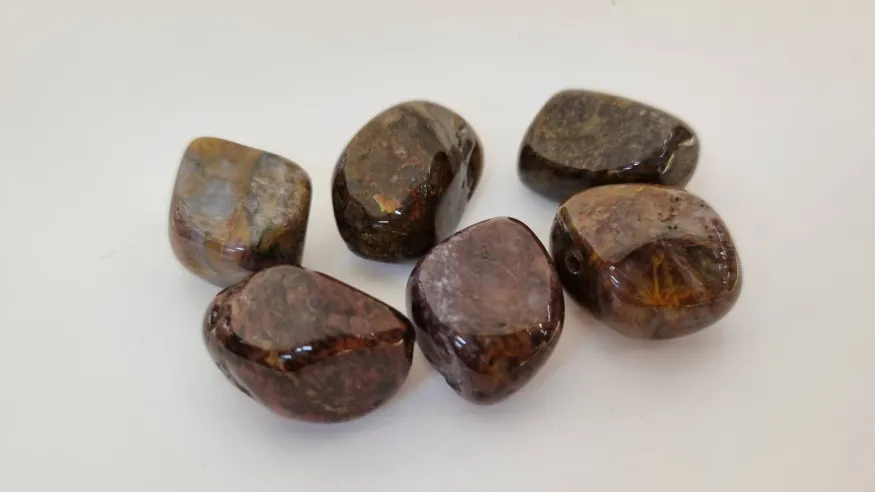
Pietersite tumbled stone
Out-of-Stock
€3.00
Pietersite tumbled stone
A petrified storm, it is the beauty of organized chaos. Cristalljoia, 40 years of minerals, find us in the center of Barcelona and online.
Pietersite tumbled stone
Minerals in our shop in the center of Barcelona and online.
Pietersite belongs to the quartz family.
Approximate sizes of the tumbled stones of this mineral:
Size 1: Approximate size: (size for sale on EBAY) 1.8 x 1.3 cm
Pietersite in tumbled stone
Pietersite is one of the most fascinating and visually complex minerals to be found in gemological collecting. This specimen in tumbled stone format stands out for its polished surface that allows one to appreciate an amalgam of colors ranging from deep blue and storm gray to strokes of gold, ochre, and reddish tones. At Cristalljoia, with a privileged location in the center of Barcelona, we have selected specimens of this mineral, also available through our online sales platform for collectors worldwide.
Often described as a "petrified storm," pietersite is not a uniform mineral, but a breccia composed mainly of fragments of tiger's eye and hawk's eye cemented by silica. This fragmented structure is what generates its appearance of organized chaos, where the fibers of the original minerals have been displaced and compacted again, breaking the usual linearity of other fibrous quartzes.
Geological characteristics of pietersite
Composition and formation of the breccia
The formation of pietersite is a unique geological process. It is a variety of chalcedony containing fibers of amphibole minerals that have undergone an alteration process. What makes this tumbled stone different from a conventional tiger's eye is its brecciated texture: the materials broke during Earth's tectonic processes and were joined back together by quartz, creating that characteristic turbulent pattern.
The most relevant technical aspects of this mineral include:
- Group: Silicates (variety of quartz/chalcedony).
- Hardness: Between 6.5 and 7 on the Mohs scale, which gives it excellent durability for decorative use.
- Lustre: Vitreous to silky, especially visible when light hits the crocidolite fibers.
- Origin: The most recognized deposits are found in Namibia and in the Henan province of China, with African specimens being highly valued for their bluish contrasts.
The phenomenon of chatoyancy in pietersite
A dynamic play of light
One of the most sought-after optical properties in pietersite tumbled stones is its chatoyancy or "cat's eye" effect. Unlike other minerals where this effect is a single, straight line, in pietersite the silky glow seems to emerge from multiple directions at once. When rotating the stone, the golden and blue areas seem to come to life, reflecting light in a changing way depending on the angle of observation.
This visual phenomenon turns each piece into a unique object; no two tumbled stones are alike, as the distribution of the fibers within the quartz matrix is completely random. This singularity is what attracts mineralogy enthusiasts looking for pieces that capture the strength of natural geological processes.
Conservation and maintenance of the mineral
Due to its silicate composition and good hardness, pietersite is a resistant mineral. However, to preserve its shine and the nuances of its internal fibers, it is recommended to avoid contact with aggressive chemicals or acids that could alter the lustre of the polished surface. For cleaning, it is enough to use a soft cloth and distilled water, thus ensuring that the tumbled stone maintains its transparency and chromatic vivacity for years.
In our shop in the center of Barcelona, we select each piece of pietersite under strict aesthetic criteria, guaranteeing that the customer receives a mineral that faithfully represents the complexity and beauty of this phenomenon of nature.
- Mineral o roca
- Pietersita
- Yacimientos
- México-Pakistán
- Chakras
- Raíz
- Signos del zodíaco afines
- Géminis-Libra
PIE.1RA
No reviews
Tap to zoom