What determines the value of a mineral?

Two amethysts, two tourmalines, two opals, or two rose quartz pieces can have very different prices while still being the same mineral. This depends on several factors that combine with one another. We go through them briefly, with examples of pieces available in our shop.

assorted minerals at Cristalljoia Barcelona
  • Color intensity: generally, the more intense the color, the higher the value.
  • Size and crystal formation: the larger and better defined, the rarer.
  • Abundance and rarity: not all minerals are equally abundant.
  • Polished or rough: the cutting and polishing work also adds value.
  • Crystal or massive: two very different forms a mineral can take; crystallized pieces are usually more valuable.
  • The piece's formation: common or truly exceptional.
assorted minerals at Cristalljoia Barcelona

Color intensity

The deep purple of amethyst, the saturated pink of rose quartz, or the well-contrasted bands in rhodochrosite and larimar raise the value far more than a dull color. Origin also creates differences within the same mineral: our Brazilian amethysts have a soft violet tone with large points, while those from Uruguay tend toward a deeper purple with smaller points, which makes them more sought after.

With opal, the difference is even clearer: the opals with play of color we bring in from Australia and Ethiopia carry a higher value than the more abundant opals from Peru, which lack that flash. Fluorite, also available in our shop, stands out for the variety of vivid colors a single piece can show, while moonstone and sunstone are valued more highly when their internal sheen is stronger.

assorted minerals at Cristalljoia Barcelona

Size and crystal formation

A large, well-formed crystal is far harder to come by than several small fragments of the same total weight, which makes it more exceptional and raises its value. We see this in our amethyst points and in quartz druzy, where dozens of tiny crystals cover an entire surface, and very visibly in cube pyrite, where every perfect cubic face adds value compared to massive pyrite, which is far more common.

assorted minerals at Cristalljoia Barcelona

Abundance and rarity

Not every mineral starts from the same baseline. Quartz, agate, or amethyst are generally abundant, so even an excellent piece remains affordable. Others are scarce in themselves: moldavite only formed in one region of what is now the Czech Republic after a meteorite impact, and larimar, also available in our shop, has only ever been found in one area of the Dominican Republic.

And within the very same mineral, there can be very different levels of rarity: green zoisite (anyolite) is relatively common, but its transparent blue variety, tanzanite, is one of the most highly prized transparent minerals in the world. Something similar happens with topaz: colorless or pale blue topaz is fairly common, while imperial topaz, with its orange-pink color, is far scarcer and more valuable. We carry exquisite topaz pieces in our shop that reflect this difference well.

assorted minerals at Cristalljoia Barcelona

Polished or rough

A rough piece is valued for how it grew naturally; a polished or cut piece is also valued for the work behind it. Agate reveals its bands once cut, and opal reveals its color once polished. The amethyst geode we carry in our shop is a special case: it's cut and polished only on the outside, leaving the crystallized interior intact, to show the formation exactly as it grew.

assorted minerals at Cristalljoia Barcelona

Crystal or massive

Tourmaline, rock crystal quartz, selenite, and tanzanite form recognizable crystals. Agate, larimar, jet, massive quartz, and zoisite are massive materials, without that structure. Calcite shows both sides of the same mineral: massive calcite is common and decorative, while optical calcite — transparent, with well-defined faces, also available in our shop — is sought after for its ability to double an image when you look through it. Opal, shungite, and moldavite go a step further: they have no internal crystalline structure at all.

assorted minerals at Cristalljoia Barcelona

The piece itself: special or standard formation

Beyond the mineral itself, each specimen can be ordinary or truly exceptional: a twin crystal, a formation combined with another mineral, a geode with an unusually striking symmetry. That's why, within the same species and the same color quality, some pieces are priced as collector's items while others remain simple decorative material.

assorted minerals at Cristalljoia Barcelona

In the end, what matters most is that you find your piece beautiful and that you love it

Stones are a bit like wine in this sense: you can learn a great deal about color, size, rarity, formation, or origin, and yet what truly determines whether a piece is "the right one" is that you like it and find it beautiful. There's no need to justify it with any technical criteria. Whether you want it to decorate a corner of your home, to start or grow a collection, to give as a special gift, or because you use it in more esoteric practices, the only judgment that really counts, in the end, is yours.

Looking for a specific mineral?

At our physical store in the centre of Barcelona we have many more options than what you see online.

If you can't find what you're looking for online, message me on WhatsApp at +34 670 61 16 63.

I'm Jéssica and I'll be happy to help.

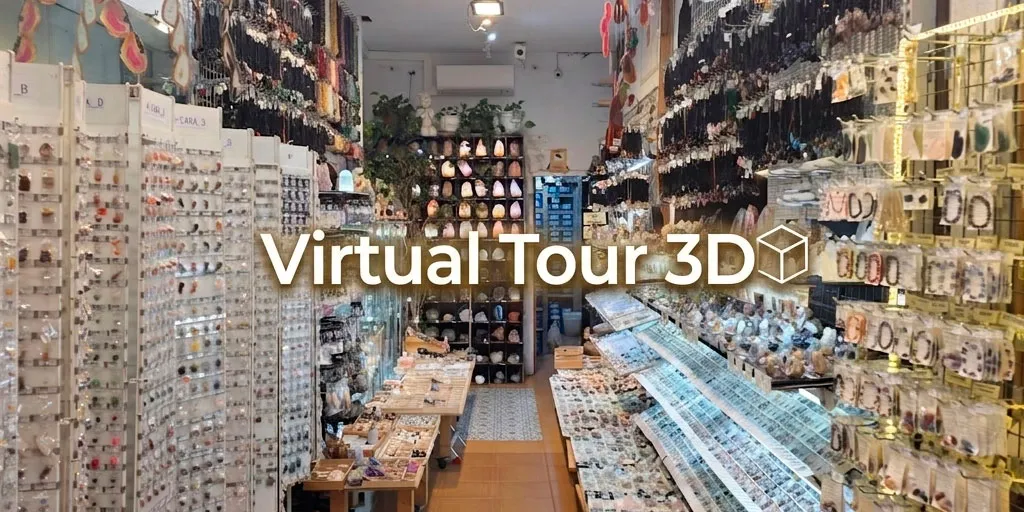
visita virtual 3D

Related products

Product added to wishlist
Product added to compare.

Looking for a mineral? Write us