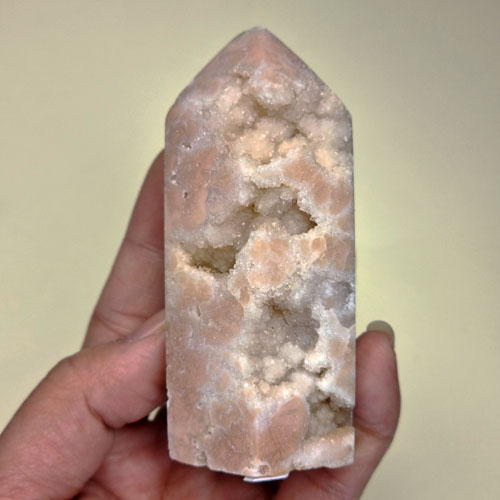
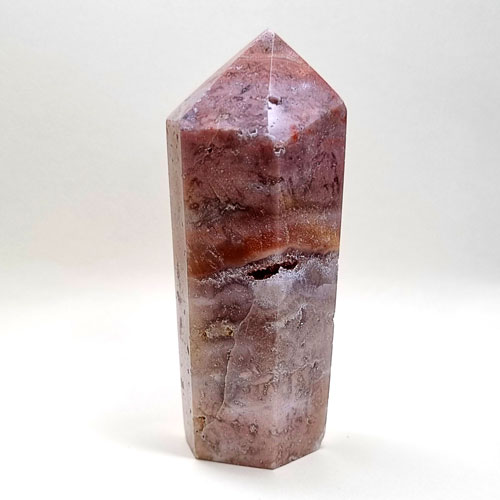
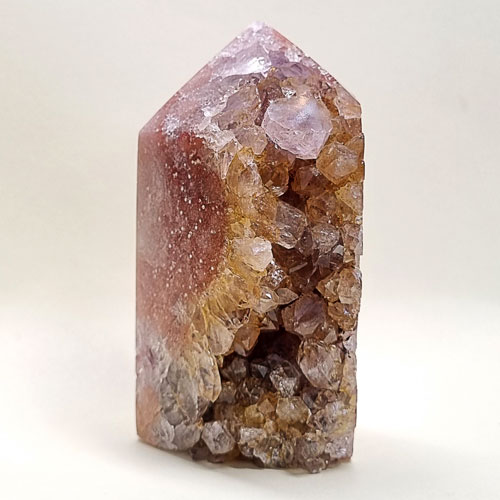
Pink amethyst point available at Cristalljoia Barcelona

Pink amethyst: what this stone really is and why its colour will surprise you

If you have ever seen a geode with pink-toned crystals and wondered whether it was rose quartz, amethyst or something entirely different, you are not alone. Pink amethyst is one of the minerals that generates the most confusion in the world of stones, and for good reason: its name, its colour and its scientific origin do not fit neatly into the usual categories.

In this article we try to explain, honestly and rigorously, what we know about this stone and what continues to be debated among specialists.

What is pink amethyst?

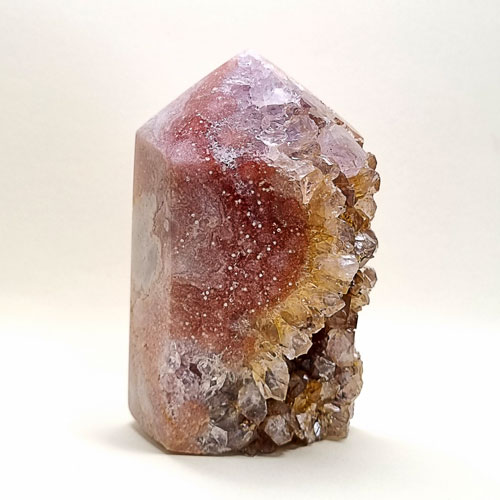
Pink amethyst is a variety of quartz with a tone ranging from pale pink to purplish pink. Visually it presents itself as pointed crystals lining the interior of geodes, with an appearance very similar to classic violet amethyst, but with that distinctive pink colour.

What makes it especially interesting from a mineralogical point of view is that it is not rose quartz in the traditional sense. According to research published in The Mineralogical Record, the colour of these stones is due to the presence of microscopic hematite particles within the quartz structure — a colouring mechanism different from both massive rose quartz and conventional purple amethyst.

Pink amethyst point available at Cristalljoia Barcelona

Is it really an amethyst?

This is where things get complicated, and we want to be transparent about it.

The term amethyst refers, by gemological definition, to a variety of quartz with a purple or violet colour. The pink tone technically falls outside that definition. This is why there is debate within the mineralogical community about whether the name "pink amethyst" is entirely correct, or whether it would be more precise to call it crystallised rose quartz or pink quartz in geode form.

However, there are also arguments in favour of the name:

  • The colour formation mechanism is similar to that of amethyst, with iron as the key element
  • The crystals have the same structure and form as amethyst crystals
  • It is a new variety, described scientifically only a few years ago, and its exact classification is still being developed
  • The name "pink amethyst" is already widely accepted in the international mineral market

In short: it is a real stone, with its own well-documented characteristics, even if its name continues to be debated among experts.

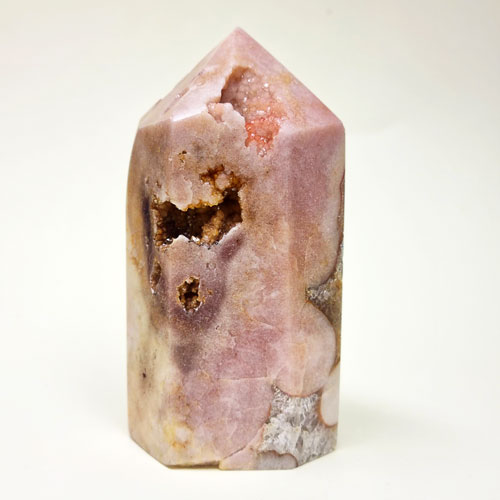
Pink amethyst point available at Cristalljoia Barcelona

How does it differ from rose quartz?

This is the question we are asked most often, and the answer is clearer:

Crystal form

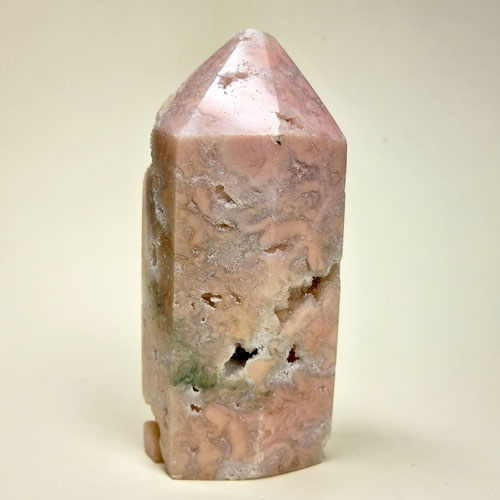
Classic rose quartz appears almost always in mass form, without well-defined individual crystals. Pink amethyst, on the other hand, forms pointed crystals visible to the naked eye, just like violet amethyst.

Colour mechanism

Rose quartz owes its colour to impurities of titanium, manganese or aluminium distributed in a diffuse way. Pink amethyst owes its colour mainly to hematite particles, which gives it a different appearance and, in the best pieces, a more vivid brilliance.

Texture and presentation

Pink amethyst is usually found in geodes with crystals pointing inward, giving it that characteristic and decorative appearance. Massive rose quartz rarely has this structure.

Pink amethyst point available at Cristalljoia Barcelona

Is it a new stone?

Relatively, yes. Although it probably existed in nature all along, it was not described scientifically until very recently. Its appearance at gem fairs and in the mineral market is a phenomenon of the last few years, which explains why many people had not heard of it until recently.

This novelty also means that there are still aspects of its mineralogy being studied, and that classifications may be refined over time.

Energetic properties attributed to pink amethyst

Pink amethyst is commonly attributed properties related to:

  • The heart chakra — it is considered a stone of love, compassion and emotional openness
  • Mental calm — partly inherited from traditional amethyst, it is associated with tranquillity and clarity
  • Emotional connection — used in meditation practices to work with emotions gently
  • Balance — combining the energy of pink with that of amethyst, it is considered a stone of transition and harmony
Pink amethyst point available at Cristalljoia Barcelona

How to tell if a pink amethyst is authentic

With the growing popularity of this stone, imitations and treated materials have appeared on the market. Some signs of authenticity:

  • The crystals should have natural colour variations — no two are exactly alike
  • The colour is not uniform or perfect — deeper areas tend to be more intense
  • The partial transparency of the crystals is common in quality pieces

At Cristalljoia we select each piece by hand, paying special attention to the quality of colour and crystal structure. Because such a singular stone deserves to be treated with the same care with which nature formed it.

Pink amethyst point available at Cristalljoia Barcelona

Much more variety at Cristalljoia

At our physical shop in the centre of Barcelona we have a much wider variety of pink amethyst products than what is visible online.

Do not hesitate to contact us if you are looking for a specific piece.

WhatsApp: 670-61-16-63

E-mail: cmd@cristalljoia.com

Looking for a specific mineral?

At our physical store in the centre of Barcelona we have many more options than what you see online.

If you can't find what you're looking for online, message me on WhatsApp at +34 670 61 16 63.

I'm Jéssica and I'll be happy to help.

visita virtual 3D

Related products

Product added to wishlist
Product added to compare.

Looking for a mineral? Write us