Uses of Minerals: Beyond Decoration and Jewelry

The same stone you wear on a ring could also be inside your phone, in a pharmacy bottle, or in the structure of a building. A look at the lesser-known uses of minerals, beyond the ornamental

When we think of minerals, we almost always think of objects: a ring, a collector's piece, a decorative crystal on a shelf. But that same stone we admire for its beauty usually has a much less visible parallel story: the story of its physical and chemical properties, which make it an essential functional material in fields ranging from medicine to aerospace engineering.

This is neither a coincidence nor marketing: hardness, electrical conductivity, the ability to vibrate at an exact frequency, or resistance to extreme temperatures are real geological properties—the same ones valued in jewelry for their shine or color. That double use, ornamental and functional, runs through almost the entire history of applied mineralogy.

In a sentence: Minerals aren't just beautiful objects: their physical properties—hardness, conductivity, piezoelectricity, heat resistance—make them key materials in medicine, technology, and industry, long before and far beyond their role in jewelry.
Uses of Minerals Cristalljoia

The misconception: when beautiful is also useful

It's easy to mentally split the world of minerals into two categories: the "beautiful" ones (gems, collector's pieces) and the "useful" ones (the kind that show up in engineering manuals). But that line is artificial. What makes quartz prized in jewelry—its flawless crystal structure, its hardness, its transparency—is exactly what makes it indispensable in a precision watch or in medical instruments.

In fact, in many cases the industrial or medical use came before, or developed alongside, the decorative one. The difference isn't in the stone itself, but in which of its properties we choose to put to work: its beauty, its hardness, its ability to conduct electricity, or its chemical behavior.

Uses of Minerals Cristalljoia

Medicine: stones that heal, calm, and repair

Some medical uses of minerals have been documented for centuries. Sulfur, for example, has been used since antiquity in dermatological treatments for its antiseptic properties, and it's still found today in creams and soaps for acne or psoriasis. Gypsum—hydrated calcium sulfate—is the basis of the plaster casts that have immobilized broken bones for over a century, and more purified variants are also used in dental and bone implants.

One of the most surprising cases is lithium. The same element we now associate with phone and electric car batteries is, in the form of lithium salts, one of the most effective treatments available for bipolar disorder, used in psychiatry since the mid-20th century. Quartz, besides its role in jewelry, is used in surgical and laboratory instruments for its chemical resistance and its ability to stay inert against most substances.

A lithium "salt," in chemistry, isn't table salt: it's what you get when you combine lithium with another element (carbonate, for instance, to form lithium carbonate) to produce a stable compound the body can absorb as medication. Pure metallic lithium is never administered directly; it's always used in this combined form.

The same element that stabilizes a psychiatric patient's mood is the one that powers the screen of the phone in your pocket: lithium doesn't distinguish between medicine and technology, only between the properties we choose to use.

Uses of Minerals Cristalljoia

Technology: the mineral hiding in your pocket

No example illustrates this double life better than quartz. Beyond being one of the most popular gems in jewelry, it has a property little known outside physics: piezoelectricity, meaning the ability to generate a small electrical current when pressure is applied to it, and to vibrate at an extremely stable frequency when an electrical current is applied to it. That property is what allows a simple quartz watch to keep time with near-perfect precision, and it underpins the electronic oscillators found in computers, radios, and communication systems.

What exactly is piezoelectricity? It's the property some crystals have of generating electricity when squeezed or slightly bent—and, conversely, of moving or vibrating when electricity is applied to them. In a quartz watch, a battery sends current to a tiny quartz crystal, which vibrates thousands of times per second with such exact regularity that it works as a "metronome" for counting the seconds.

Lithium, already mentioned for its medical use, is today the critical element in the rechargeable batteries that power everything from phones to electric cars, which has made it one of the most strategic—and geopolitically contested—minerals of the 21st century. Corundum, the same mineral that in its gem varieties produces ruby and sapphire, is also manufactured synthetically (that is, created in a lab with the same chemical composition as the natural mineral) to produce highly scratch-resistant crystals, used in watch screens and high-end optical components.

Piezoelectricity isn't exclusive to quartz, but it's the mineral in which it was discovered and where it's put to the best industrial use. It was first described in 1880 by brothers Pierre and Jacques Curie, two young researchers aged 25 and 21 working as laboratory assistants in Paris, more than a century before the first commercial quartz watch existed.
Uses of Minerals Cristalljoia

Industry: the minerals holding up construction and manufacturing

Beyond high technology, much of heavy industry depends on common minerals we rarely associate with their geological origin. Limestone and gypsum are essential ingredients in the cement and concrete that hold up virtually all modern construction. Feldspar is a key raw material in the manufacture of ceramics and glass, while talc—one of the softest minerals there is—is used in the paper, plastics, and cosmetics industries as an anti-caking agent and lubricant.

An "anti-caking agent" is, quite simply, a substance added to a powdered product so its particles don't stick together and form clumps. Talc does this job in cosmetics and plastics because its microscopic sheets slide over one another without binding.

Graphite, the mineral form of carbon, has gone from being the classic pencil-lead component to becoming a strategic material in lithium battery manufacturing and high-temperature metallurgical processes. These are minerals almost never sold as collector's pieces, yet without them much of contemporary industry simply wouldn't function.

Uses of Minerals Cristalljoia

What these uses have in common with jewelry

The hardness that lets a quartz ring withstand everyday knocks is the same hardness that makes it a good industrial abrasive. The crystal structure that gives a sapphire its shine is the same one put to work, in its synthetic form, to manufacture scratch-resistant crystals. There aren't two different minerals—the "beautiful" one and the "useful" one—there's one stone and different ways of looking at it.

Understanding that continuity is, at its core, what it means to truly understand minerals: not just as objects of aesthetic desire, but as materials with a geological, chemical, and functional history that extends far beyond a jewelry shop window.

In summary: The minerals we value for their beauty are, in many cases, the same ones that underpin entire fields of medicine, technology, and industry. Quartz keeps time with precision thanks to its piezoelectricity, lithium stabilizes batteries as well as the mood of psychiatric patients, and minerals as common as limestone or gypsum literally hold up modern construction. The difference between ornamental use and functional use isn't in the stone—it's in which of its properties we choose to put to work.

Frequently asked questions

What minerals are used in medicine?

Among the most common are sulfur, used in dermatological treatments; gypsum, the basis of plaster casts and bone implants; lithium, used in psychiatry for bipolar disorder; and quartz, used in medical instruments for its chemical inertness.

Why is quartz used in watches and electronic components?

Because it's piezoelectric: when electrical current is applied to it, it vibrates at an extremely stable frequency. That property, discovered in 1880, allows for highly precise timekeeping and helps stabilize electronic signals in computers and communication systems.

Which minerals are strategic for today's technology?

Lithium, essential for the rechargeable batteries in phones and electric cars, is probably the most geopolitically contested. Quartz and synthetic corundum (used in scratch-resistant screens) also play a key role in consumer electronics.

What minerals are used in construction?

Limestone and gypsum are key components of cement and concrete. Feldspar is used in ceramics and glass, and talc appears in construction materials, plastics, and cosmetics as a lubricant and anti-caking agent.

Is a jewelry-grade mineral the same as an industrial-use one?

Often, yes—it's the same mineral. What changes is the property being put to use. The hardness and crystal structure that make quartz attractive in a ring are the same ones that make it useful in watchmaking, medical instruments, or industrial abrasives.

Looking for a specific mineral?

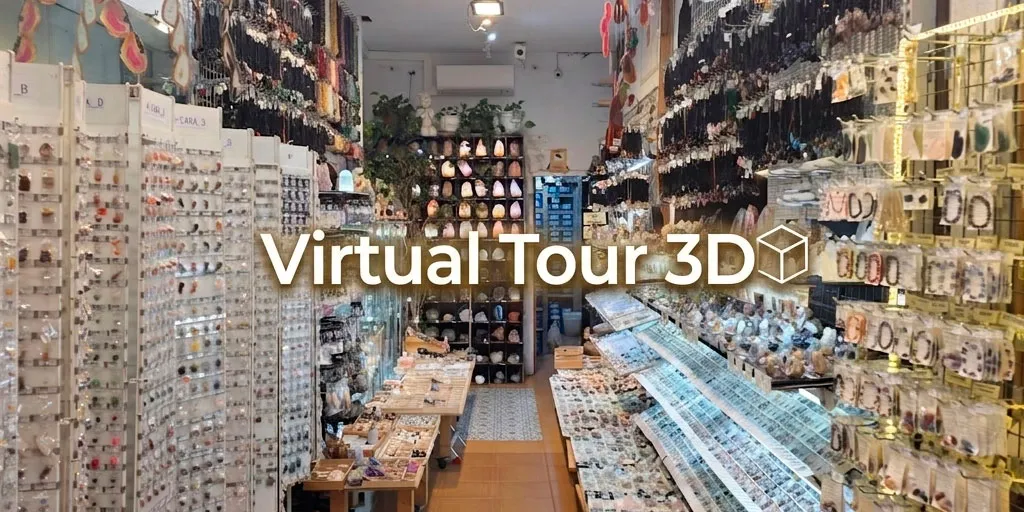
At our physical store in the centre of Barcelona we have many more options than what you see online.

If you can't find what you're looking for online, message me on WhatsApp at +34 670 61 16 63.

I'm Jéssica and I'll be happy to help.

visita virtual 3D
Product added to wishlist
Product added to compare.

Looking for a mineral? Write us