Where mineral names come from: five ways to christen a stone

Amethyst, hematite, labradorite, morganite, dolomite... every mineral name hides a small human decision: who was honoured, which place was remembered, which property caught the eye first

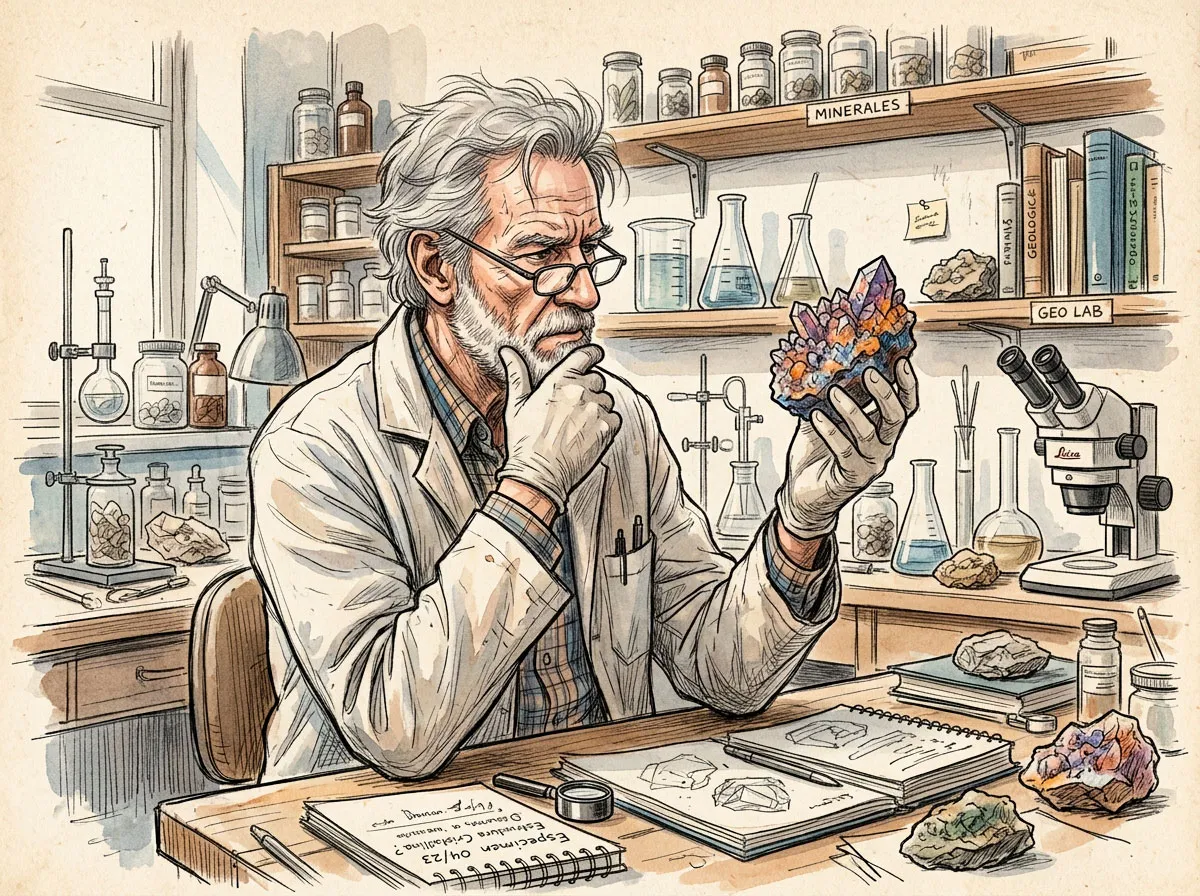
Anyone who starts taking an interest in minerals eventually asks the same question: why are they called that? Mineral names are not arbitrary or decorative. Each one is, in effect, a small historical record: it notes who first described the mineral, where it was found, which feature stood out, or which ancient story became attached to it long before mineralogy existed as a science. Behind every name lies a decision — made by a specific person, at a specific moment — and that decision is still governed today by an international body.

Looked at calmly, almost every mineral name fits into one of five broad groups: people, places, physical properties, chemical composition, or mythology and ancient languages. Knowing these five groups completely changes the way you read a label in a collection: it stops being a strange word and starts telling a story.

In one sentence: Mineral names almost always fall into five categories: tributes to people, references to places, descriptions of a physical property, allusions to chemical composition, or inheritances from mythology and ancient languages. Since 1959, every new name must also be approved by an international IMA commission.
Mineral Names. Cristalljoia

1. Tributes to people: "eponymous" minerals

This is by far the largest category today. A mineral is named after a person — a mineralogist, a geologist, a collector, even someone entirely outside science — as recognition for their work or their role in the discovery of the piece. Goethite, for example, honours the writer and naturalist Johann Wolfgang von Goethe, who, alongside literature, had a serious interest in geology. Sillimanite recalls the American chemist Benjamin Silliman, and dolomite — both the rock and the mineral — takes its name from the French geologist Déodat de Dolomieu, who first described it in the Alps that today also carry his name: the Dolomites.

Sometimes the tribute goes not to a scientist but to someone linked to the trade or collecting of the stone. Kunzite is named after George Frederick Kunz, the Tiffany & Co. gemologist who identified it as a new variety of spodumene in the early twentieth century, and morganite honours J. P. Morgan, the banker and collector who financed a great many gemological expeditions of the era.

Mineral Names. Cristalljoia

2. The place it was found: place names turned into minerals

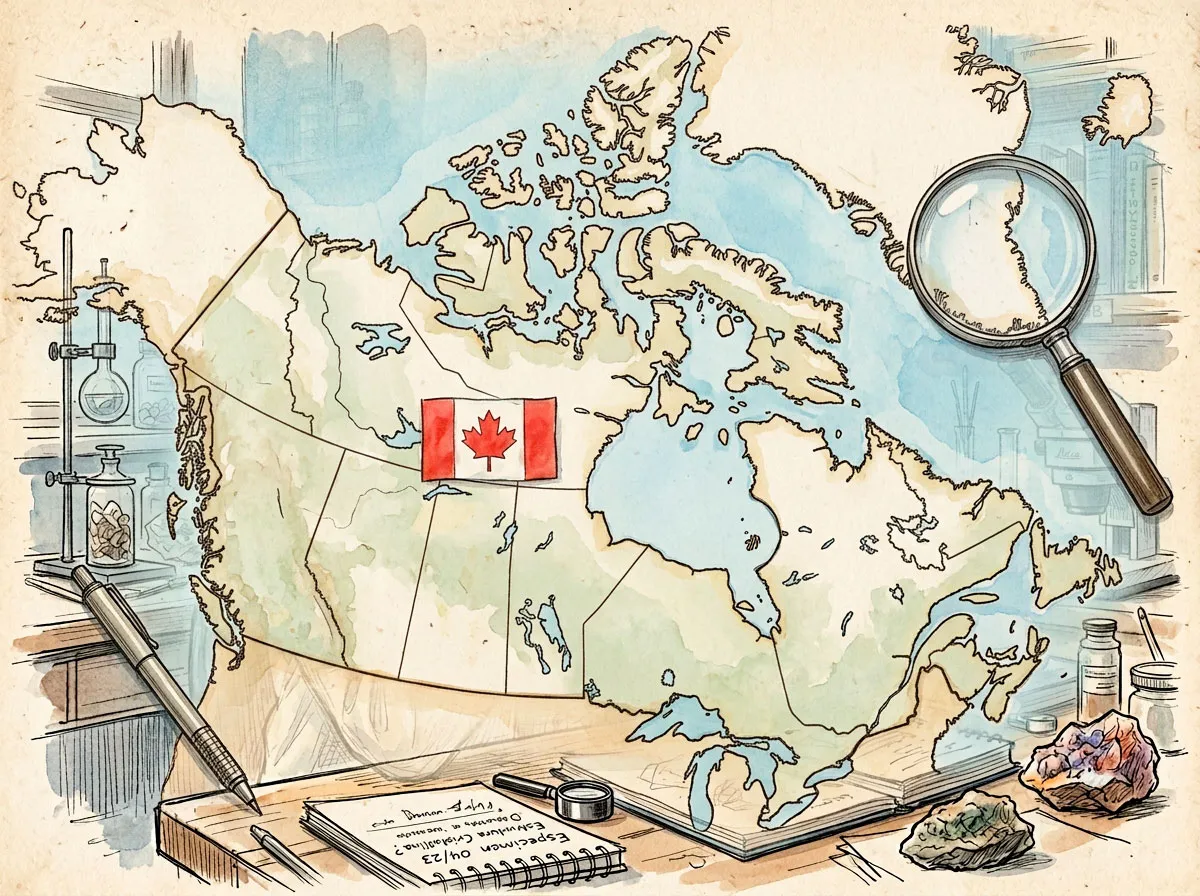
Another large group takes its name directly from the place where the mineral was first described, or from a region historically associated with it. Labradorite is named after the Labrador Peninsula in Canada, where its characteristic play of colour was first documented. Turquoise, curiously, does not owe its name to any deposit in Turkey: it reached Europe via Turkish traders, even though the stones originally came from Persia, and the name — "Turkish stone" — stuck because of the trade route, not the geological origin.

A particularly telling case is tanzanite, discovered in 1967 at the foot of Kilimanjaro: at the time, only a single deposit was known anywhere in the world, in Tanzania, and the name — proposed, in fact, by Tiffany & Co. itself to make it easier to market — has stayed tied to that country ever since.

What if the same mineral turns up in several places? The name doesn't change. Once fixed — usually from the first scientifically described deposit, known as the "type locality" — the name is kept even if the same mineral is later found on other continents. That's why there's labradorite in Madagascar or turquoise in the United States: the name travels with the mineral, not with the map.
Mineral Names. Cristalljoia

3. What you can see at a glance: physical and optical properties

Many of the oldest names simply describe the first thing that caught the eye of whoever observed them, almost always in Greek or Latin. Hematite takes its name from the Greek haima, "blood," because when ground to powder it leaves an intense red streak, even though the raw piece is metallic grey. Graphite comes from the Greek graphein, "to write," a direct reference to its use for leaving a mark on a surface. Barite owes its name to the Greek barys, "heavy," because its density — much higher than that of other, similar-looking minerals — was precisely what allowed it to be identified as something different.

This category is especially revealing because it shows how, before modern chemistry existed, the only classification tool available was the senses: colour, weight in the hand, the way a mineral behaved when scratched or ground.

Mineral Names. Cristalljoia

4. What's inside: names tied to chemical composition

With the development of chemistry, mainly from the nineteenth century onward, it became common to name a mineral directly after the elements it's made of. Halite — rock salt — takes its name from the Greek hals, "salt," a clear reference to its composition of sodium chloride. Cuprite owes its name to copper, an element that makes up a very high proportion of it, and calcite refers directly to calcium, its fundamental element.

Over time, this logic has become the most common approach for new minerals: when the chemical composition is distinctive enough, it turns out to be the most practical and least ambiguous criterion for naming a species.

Mineral Names. Cristalljoia

5. Echoes of mythology and ancient languages

The last major category is also the most narrative. Amethyst takes its name from the Greek amethystos, "not intoxicated," because in ancient Greece the stone was believed to protect against drunkenness; a later legend even added the nymph Amethyst, turned to stone by the goddess Artemis. Selenite — a variety of gypsum with a pearly appearance — honours Selene, the Greek goddess of the moon, for its soft sheen and milky transparency. Topaz, for its part, has a more uncertain origin: some sources link it to Topazios, an island in the Red Sea where the ancients believed they had found it, others to the Sanskrit root tapas, "fire" or "heat."

A mineral name is, almost always, the trace left by the first person who paused to look at it closely: what they saw, where they were, and whom they wanted to remember when they put it into words.

Mineral Names. Cristalljoia

A curious note: no one can name a mineral on their own today

Until the mid-twentieth century, any scientist describing a new mineral could give it whatever name they liked, which led to centuries of duplicates, synonyms, and confusion. That changed in 1959, when the Commission on New Minerals and Mineral Names was created, today part of the Commission on New Minerals, Nomenclature and Classification (CNMNC) of the International Mineralogical Association (IMA). This commission, made up of representatives from national mineralogical societies, is responsible for controlling the introduction of new minerals and rationalising mineral nomenclature worldwide: since then, no new mineral is officially valid until its name — along with its chemical and crystallographic description — receives approval from this international committee.

Mineral Names. Cristalljoia

What this has to do with how we look at minerals today

Knowing where a mineral's name comes from is not a trivial detail: it's a door into its history. A name can tell us who first studied it, in which country it was found, which feature was so obvious it became its calling card, or which ancient story became attached to it long before the science that explains it existed. Reading a label with that mindset — rather than just memorising a word — is, once again, the same attitude we bring to any other mineral: understand first, admire after.

In summary: Mineral names fall into five broad categories: people (goethite, sillimanite, kunzite, morganite, dolomite), places (labradorite, turquoise, tanzanite), physical properties (hematite, graphite, barite), chemical composition (halite, cuprite, calcite), and mythology or ancient languages (amethyst, selenite, topaz). Since 1959, every new name must be approved by the Commission on New Minerals, Nomenclature and Classification (CNMNC) of the IMA.

Looking for a specific mineral?

At our physical store in the centre of Barcelona we have many more options than what you see online.

If you can't find what you're looking for online, message me on WhatsApp at +34 670 61 16 63.

I'm Jéssica and I'll be happy to help.

visita virtual 3D
Product added to wishlist
Product added to compare.

Looking for a mineral? Write us