Recrystallized Bismuth: The "Alien" Crystal Born from Metal

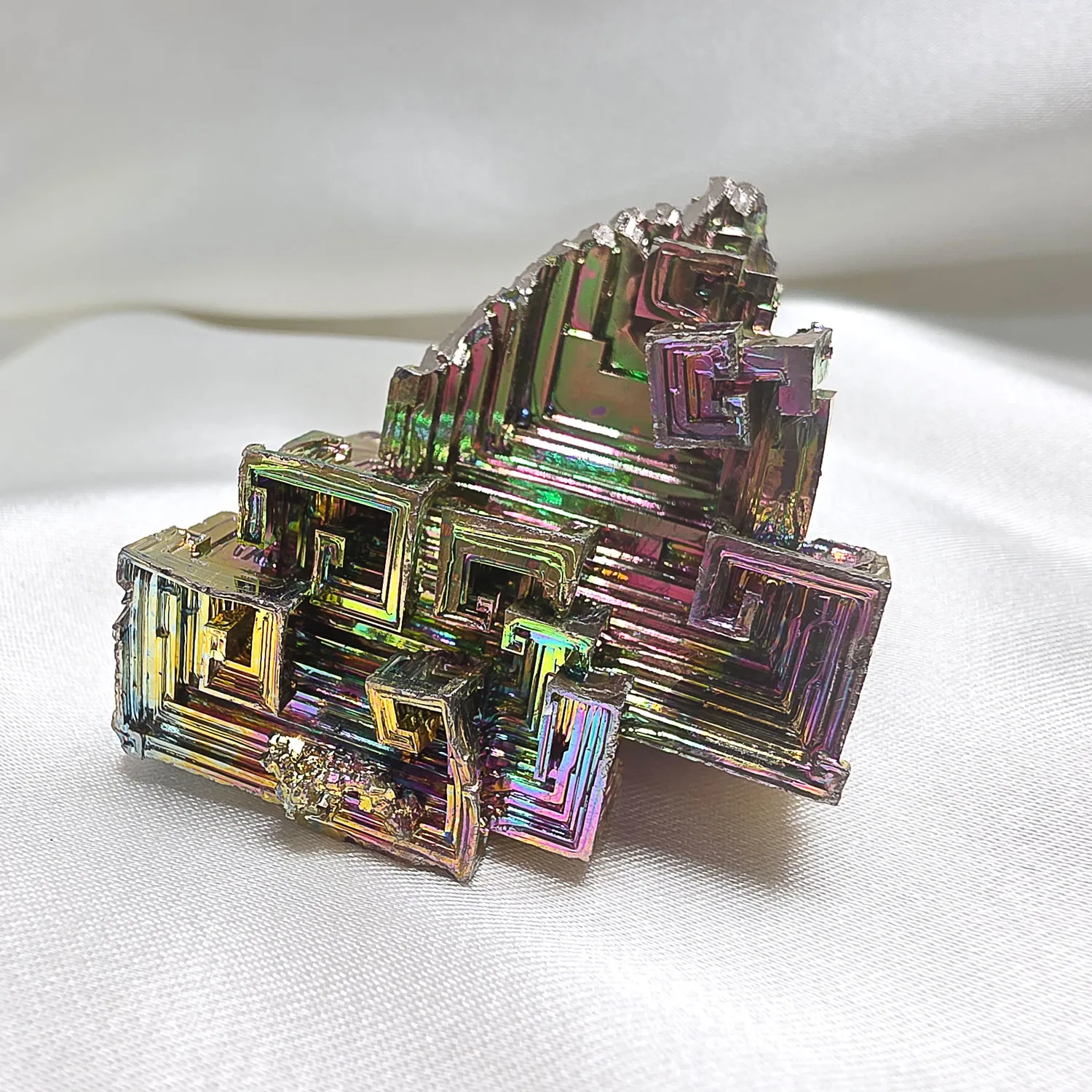
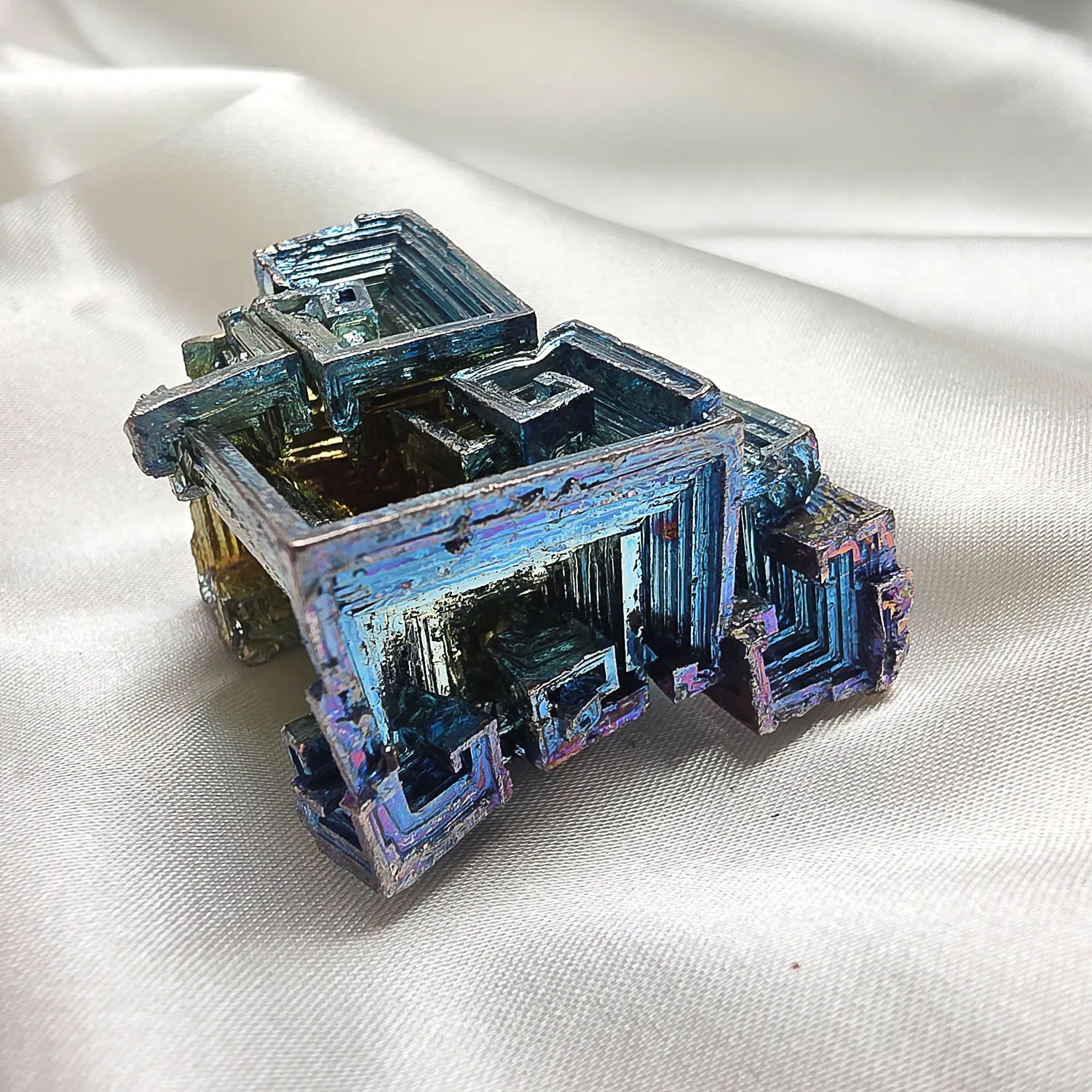
Few pieces capture attention quite like recrystallized bismuth. Its staircase-like structures, near-impossible geometry, and iridescent range of colors have turned it into a genuine sensation among collectors. But the most surprising part isn't just its appearance: unlike most collectible specimens, it isn't created by nature, but by the laboratory.

In one sentence: recrystallized bismuth is metal melted and cooled on purpose so it forms geometric crystals. It isn't a mineral found this way in nature: it's science turned into a collectible object.

What exactly is recrystallized bismuth?

Bismuth is a metallic chemical element, number 83 on the periodic table. In its natural form it's a dull, whitish-gray metal, nothing spectacular. The "recrystallized bismuth" sold as a collectible piece is high-purity bismuth that has been melted and allowed to solidify under controlled conditions, giving rise to those characteristic stepped structures.

Unlike moldavite or quartz, this isn't a geological process spanning millions of years, but a repeatable technical process: the metal is heated past its melting point (271 °C) and, as it cools, its atoms rearrange themselves into crystals visible to the naked eye.

A mineral… that isn't a mineral. Although it's sold alongside stones and minerals, recrystallized bismuth is actually an artificially crystallized pure metal. Its origin is the laboratory, though the physical phenomenon that produces it is completely real and natural.

The process: how a metal staircase is born

Bismuth has two key properties that explain its very particular appearance. The first is that it's a terrible heat conductor: as the molten metal begins to cool, the outer surface in contact with air loses temperature much faster than the interior.

This causes solidification to progress from the outside in, with crystals growing faster at the edges than in the center. The result is those stepped, spiraling shapes that look hand-carved but actually emerge on their own from the cooling process itself.

Physics curiosity: bismuth also exhibits anisotropic thermal expansion, meaning it expands differently depending on direction as temperature changes. This further reinforces the emergence of its unique geometric patterns.

And where do those colors come from?

Pure bismuth has a silvery tone with a slight pinkish tint. The show of colors — from gold to blue, passing through violet — doesn't come from the metal itself, but from a thin oxide layer (bismuth oxide) that forms on the surface upon contact with air during cooling.

Depending on the thickness of that oxide layer, light reflects differently, generating distinct colors through interference — a bit like what happens with oil slicks on water or the surface of a CD.

  • Base color of the metal: silvery-gray with a pinkish tint.
  • Visible colors: oxide layer ranging from yellow to dark blue, depending on its thickness.
  • Formation: melted metal recrystallized under controlled conditions, not a natural mineral.
  • Melting point: 271 °C, relatively low for a metal.

A piece that never repeats. Even though the process is artificial and controlled, no two pieces of recrystallized bismuth come out the same. Small variations in cooling speed and oxide layer thickness make every structure and every color range one of a kind.

From the lab to the collector's display case

Recrystallized bismuth doesn't have an ancient tradition like other gems: its popularity as a collectible is relatively recent, driven by its almost otherworldly appearance and the ease with which it can be produced in a controlled setting.

Today it's used almost exclusively for decorative and collecting purposes: pendants, display pieces, curious gifts, or simply as an object of scientific fascination on a shelf. It's also used for educational purposes, as a striking visual example of how crystals form.

Did you know…? Bismuth can even be melted at home using kitchen tools set aside solely for this purpose, though handling molten metal above 270 °C requires great care and, whenever possible, supervision from someone with experience.

Frequently asked questions about recrystallized bismuth

Is recrystallized bismuth a mineral?

  • Not strictly speaking: it's a pure metal that has been melted and recrystallized.
  • The process is done in a lab, not a natural geological phenomenon.
  • It's sold alongside minerals for its visual appeal, though its origin is different.

How do its stepped crystals form?

  • Bismuth conducts heat very poorly, so it cools from the outside in.
  • Crystals grow faster at the edges than in the center.
  • That difference in speed creates the characteristic spiral, staircase shape.

Why does it have such striking colors?

  • The colors don't come from the metal itself, but from a thin oxide layer on the surface.
  • Depending on the thickness of that layer, light reflects differently.
  • The result is a range that goes from gold to blue or violet.

Can you make recrystallized bismuth at home?

  • In theory yes, since its melting point is relatively low (271 °C).
  • It requires containers and utensils that afterward should never be used for food again.
  • It's recommended to do it with caution or with the help of someone experienced.

Is bismuth toxic?

  • It's one of the few heavy metals considered to have very low toxicity.
  • It's commonly handled in workshops and even in educational activities with children.
  • Even so, the main risk when handling it comes from the high melting temperatures.

Is it the same as a natural crystal like quartz?

  • No: quartz forms naturally over long geological periods.
  • Recrystallized bismuth is produced through a controlled process that's much faster.
  • They share the fact of having a crystalline structure, but their origin is very different.

Why is every piece different?

  • Small variations in cooling speed change the final shape.
  • The thickness of the oxide layer also varies from one piece to another.
  • That's why no two pieces of recrystallized bismuth are ever identical.

Looking for a specific mineral?

At our physical store in the centre of Barcelona we have many more options than what you see online.

If you can't find what you're looking for online, message me on WhatsApp at +34 670 61 16 63.

I'm Jéssica and I'll be happy to help.

visita virtual 3D

Related products

Product added to wishlist
Product added to compare.

Looking for a mineral? Write us