Why such extraordinary fossils come from Morocco: the geological story behind every piece

Trilobites, orthoceras, ammonites, Spinosaurus teeth... the Moroccan Sahara isn't just desert: it's the floor of several ancient seas, now laid bare

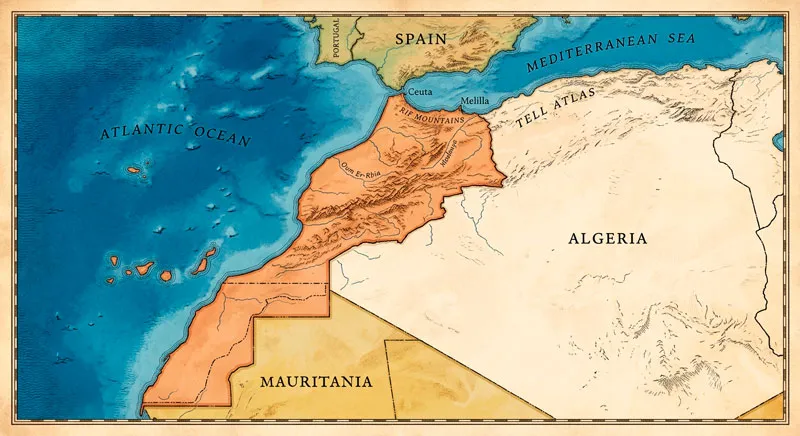
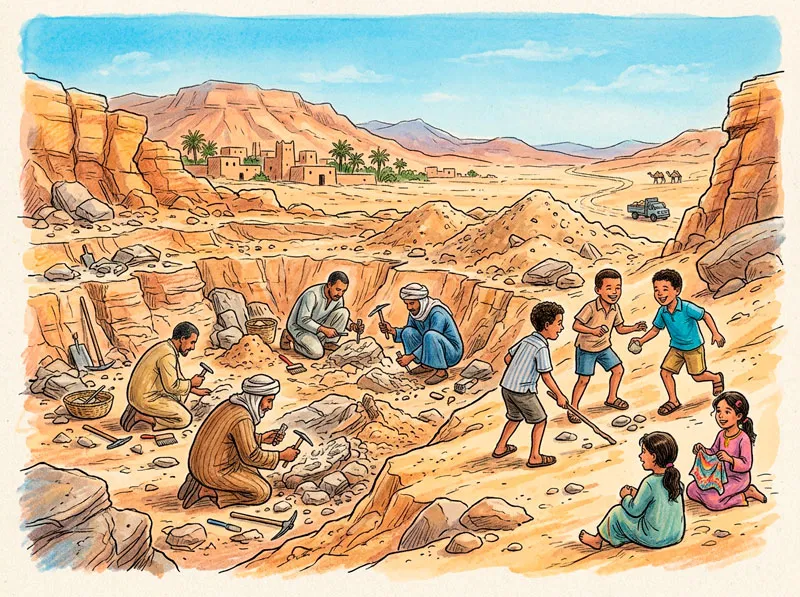
Anyone who has seen a black marble table with orthoceras embedded in it, or a trilobite perfectly preserved with its eyes and segmented shell intact, has asked the same question: why do so many come out of Morocco, and with that level of detail? The answer isn't chance or geographic luck. It's the combination of four factors that rarely coincide in the same place: that part of the Sahara lay under the sea for hundreds of millions of years — several times, in different eras —, the type of sediment deposited there preserves detail with unusual precision, today's climate, arid and almost devoid of vegetation, leaves the rock layers completely exposed, and there is a local tradition, spanning several generations, dedicated to extracting and preparing them.

None of these four factors on its own would explain the abundance and quality we see today in shops and collections. It's the sum of them that turns southeastern Morocco, and specifically the area around Erfoud, Alnif and Rissani, into one of the most fossil-rich territories on the planet.

In one sentence: Morocco holds extraordinary fossils because its territory was covered by ancient seas in several distinct eras (first Paleozoic seas more than 380 million years ago, later Cretaceous river deltas around 100 million years ago), because the type of rock that formed there — fine-grained limestone and silt — preserves detail with great precision, because erosion in today's desert leaves those layers exposed with barely any digging, and because a local artisanal industry exists, built on generations of experience, dedicated to locating, extracting and preparing them.
Extraordinary fossils from Morocco. Cristalljoia

1. One territory, several different seas

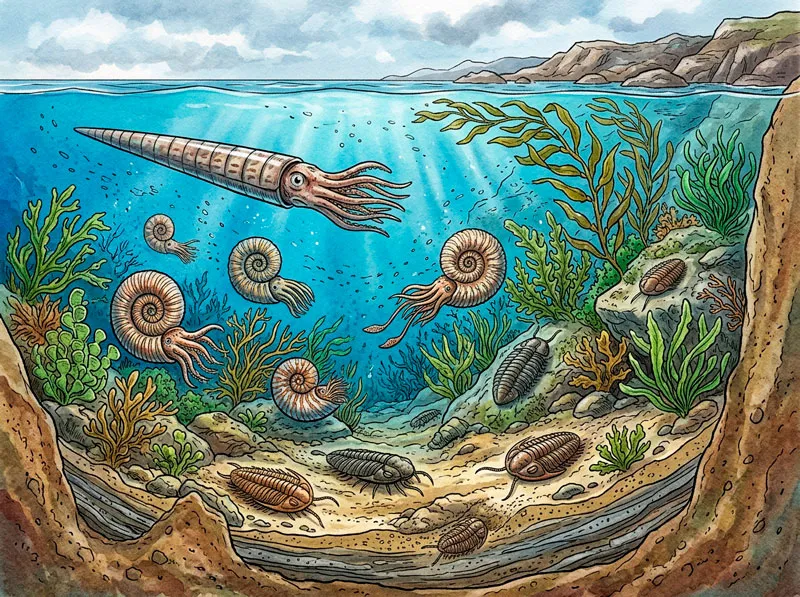
The first thing to understand is that the Moroccan Sahara wasn't under the sea just once, but in at least two major periods separated by hundreds of millions of years. During the Devonian, around 380 million years ago, the Rissani area was part of the floor of a warm, shallow sea, one of the early proto-Tethys seas. That's the sea that left behind the ammonites, the goniatites, the crinoids and, above all, the orthoceras: those molluscs with long, straight shells, distant relatives of today's nautilus, which now appear in thousands of polished "marble" slabs.

Long before that Devonian sea, in the Cambrian and Ordovician — more than 480 million years ago — the same region had already been a seafloor, and it's from that period that the trilobites come which made the Anti-Atlas and Alnif region famous. And there was still a third episode, much more recent: during the Cretaceous, around 100 million years ago, the area known as Kem Kem — a rock escarpment stretching nearly 250 kilometres across the southeast of the country — was a river delta inhabited by dinosaurs such as Spinosaurus and Carcharodontosaurus, before the advancing sea covered the region once again. Three completely different settings, stacked one on top of another in the same mountains.

Extraordinary fossils from Morocco. Cristalljoia

2. Why they're preserved in such detail

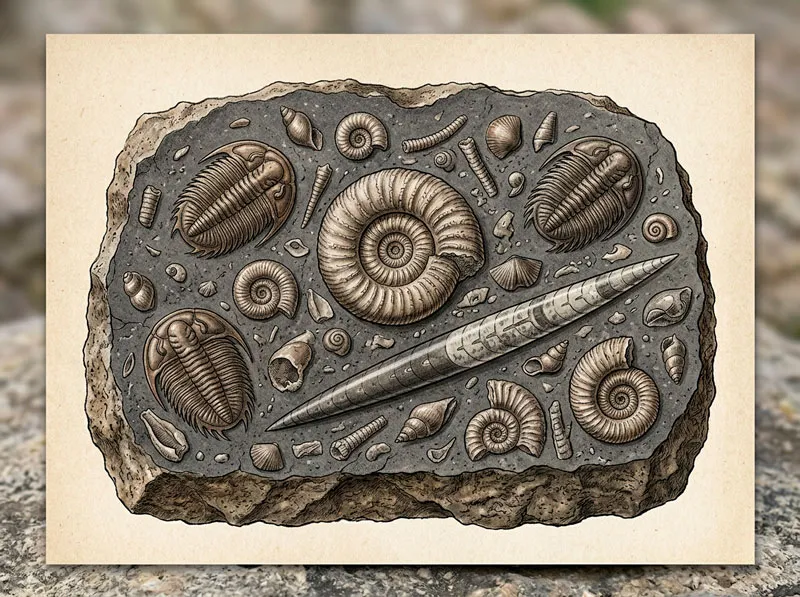
Having once been sea doesn't by itself guarantee beautiful fossils: the sediment that covered those organisms also had to be the right kind. In the Erfoud and Rissani area, remains were buried in very fine calcareous mud, deposited gently in relatively calm waters. As that mud compacted, it turned into a very fine-grained limestone, able to mould itself around a shell or a carapace without crushing or distorting it, preserving details as delicate as the facets of a trilobite's compound eye or the sutures of an ammonite.

It's exactly this type of rock — fossiliferous limestone, not true metamorphic marble — that gets cut and polished in Erfoud's workshops to make tables, sinks or fountains with visible orthoceras: what's sold commercially as "Erfoud marble" is, in reality, a slab of limestone packed with thousands of marine fossils, cut at just the right angle so they show up in cross-section.

Extraordinary fossils from Morocco. Cristalljoia

3. The desert, an unexpected ally

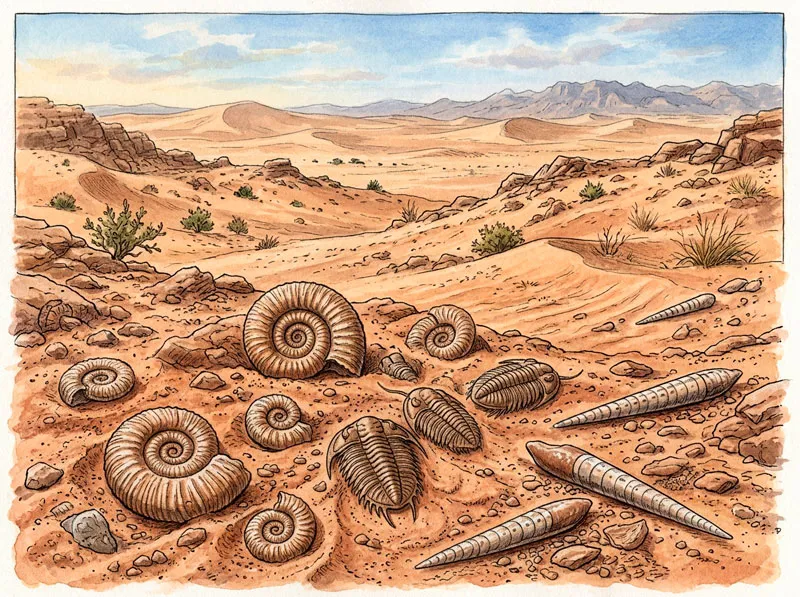
A perfect fossil is of no use if it stays buried under metres of rock. This is where today's Sahara climate comes in: extreme aridity and the almost total absence of vegetation and topsoil mean erosion — from wind, from the scarce but intense rains, from sharp temperature swings — wears the rock down layer by layer, exposing the strata like the pages of an open book. The Kem Kem escarpment itself is, quite literally, a rock wall dozens of metres high where you can read, from top to bottom, the succession of ancient environments.

In wetter parts of the world, that same fossil-bearing rock would still exist underground, but covered by vegetation, soil and recent sediment, invisible to anyone who doesn't deliberately dig for it. In the Moroccan Sahara, by contrast, much of the "excavation" work has already been done by the climate itself over millions of years.

So why do so many look "too perfect"? It's worth being honest here: the Moroccan fossil market also includes restored pieces, ones reconstructed from fragments, or outright composites made with resin and parts from several specimens. This isn't a rare exception — it's common with high-end trilobites and very symmetrical pieces. It doesn't take away from the real geological story, but it does matter to always buy through sources that explain clearly what's naturally fossilised and what's restoration.
Extraordinary fossils from Morocco. Cristalljoia

4. A craft tradition spanning generations

The last factor is human, not geological. Around Erfoud, Alnif and Rissani, a local economy has existed for decades built around searching for, extracting, preparing and selling fossils: entire families who know by heart which quarry each type of piece comes from, workshops that have spent generations polishing orthoceras slabs, and a practical knowledge — where to look, how to free a trilobite without breaking it, how to prepare the surface without damaging the specimen — that isn't learned from a manual, but by watching the previous generation.

This human element partly explains why Morocco, and not other regions of the planet with a similar geological history, has become the world reference point for the fossil market: it isn't enough for the rock to contain them — the infrastructure and accumulated experience to bring them to light without destroying them are needed too.

Every Moroccan fossil has made two journeys: first, hundreds of millions of years beneath layers of rock; then, generations of hands who learned to find it and free it without breaking it.

Extraordinary fossils from Morocco. Cristalljoia

A curious note: the "marble" that isn't actually marble

In the strict geological sense, marble is a metamorphic rock: limestone transformed by heat and pressure until it recrystallises. What's sold as "Erfoud marble" with orthoceras is, almost always, sedimentary limestone that has never been metamorphosed, simply cut and polished to a shine. The commercial name has stuck through custom, not mineralogical precision — a case rather similar, in fact, to the many mineral names born from tradition that stay fixed even after the science moves on.

In summary: Morocco is rich in extraordinary fossils because southeastern Morocco was seafloor in at least two major eras separated by hundreds of millions of years (Cambrian–Ordovician and Devonian seas, followed later by Cretaceous river deltas), because the fine sediment that covered them — limestone and silt — preserves detail with great precision, because today's arid climate exposes those layers through erosion with barely any digging required, and because a local craft tradition spanning several generations exists to extract and prepare them. When buying high-end pieces, it's always worth checking what percentage is naturally fossilised and what percentage is restoration.

Looking for a specific mineral?

At our physical store in the centre of Barcelona we have many more options than what you see online.

If you can't find what you're looking for online, message me on WhatsApp at +34 670 61 16 63.

I'm Jéssica and I'll be happy to help.

visita virtual 3D
Product added to wishlist
Product added to compare.

Looking for a mineral? Write us