Minerals of Ancient Egypt: the chemistry behind the makeup, the mummies and the temples

Kohl, natron, lapis lazuli, alabaster: the Egyptians didn't choose their minerals out of superstition, but because they knew their physical and chemical properties with precision. A journey through the real mineralogy behind the myths

When we think of Ancient Egypt and minerals, we almost always picture the same things: the gold of Tutankhamun's mask, the deep blue of lapis lazuli, the black-lined eyes in a fresco. These images are real, but incomplete. Behind each one was a civilization that ground, mixed, heated and combined minerals with a precision we would today recognize as applied chemistry, not magic.

It's no coincidence that the word "chemistry" itself, according to one of the most widely accepted etymological hypotheses, has a root in kemet, the name the Egyptians gave to their land. Egypt didn't just use minerals: it processed and combined them for very specific purposes. That is the thread running through this journey.

In one sentence: The Egyptians used minerals like galena, malachite, natron, lapis lazuli and alabaster not out of belief, but for their real properties — color, hardness, texture or drying capacity — later wrapped in religious and symbolic language.
Minerals in Ancient Egypt Cristalljoia

The misunderstanding: ritual doesn't mean ignorance

It's easy to look at Egyptian makeup, amulets or funerary rituals and file them away as pure symbolism, with no material basis. But the archaeological record says otherwise: every mineral was chosen for a specific functional reason, even when that reason was explained in religious terms. Kohl didn't just "invoke Horus": it also protected the eyes from the desert glare. Natron wasn't just a "divine salt": it was, quite literally, a mineral with a highly effective drying capacity.

This double reading — symbolic and functional at the same time — is the key to understanding Egyptian mineralogy without falling into either the esoteric myth or the oversimplification of "it was just decoration." The Egyptians explained with gods what we explain today with geological properties, but the empirical observation behind it was real.

Minerals in Ancient Egypt Cristalljoia

Kohl: a mineral cosmetic for everyday use

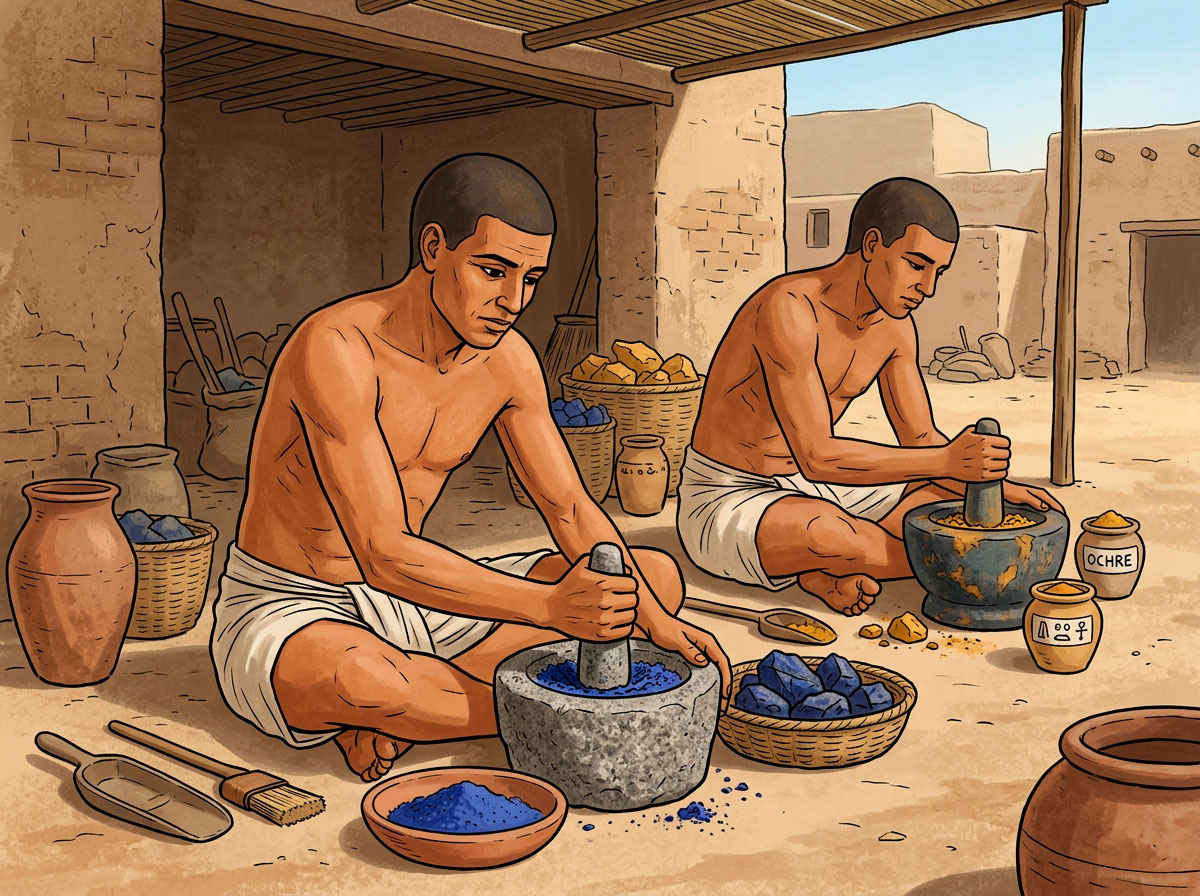
Kohl — mesdemet in Egyptian — was a powdered cosmetic applied around the eyes to darken the eyelids, something similar to a modern eyeliner or eyeshadow. It was worn daily by both men and women, with no social distinction, and was made by grinding minerals into a very fine powder that was then mixed with water or fats to form a paste.

The most common mineral for the black tone was galena, dark gray with a metallic luster. Green came from malachite, and in higher-status pieces, blue was achieved with crushed lapis lazuli, far scarcer and therefore reserved for the elite. Palettes and small stone grinding rollers, used precisely to crush these minerals before use, have been found systematically in Egyptian tombs.

Beyond the religious meaning of each color — black linked to the fertility of the Nile silt, green to Horus, blue to the sky and the divine — kohl served a very practical purpose: reducing glare from the intense desert sun, something similar to what we seek today with sunglasses or the eye black used by some athletes.

The same gesture of grinding a mineral into pigment, which we now associate with cosmetics or art, was in Egypt a daily routine shared by the entire population, regardless of gender or social class.

Minerals in Ancient Egypt Cristalljoia

Natron: the salt that made eternity possible

If kohl is Egypt's cosmetic mineralogy, natron is its funerary mineralogy. Natron is, in essence, a mineral salt that formed naturally on the shores of salt lakes such as those of the Wadi El Natrun, northwest of Cairo, where water evaporated under the sun and left crystalline crusts ready to be collected.

What does "hydrated sodium carbonate" mean? In simple terms: natron is a salt related to the baking soda we use in the kitchen today, made up mainly of sodium combined with carbon, oxygen and hydrogen. "Hydrated" simply means its structure has water molecules built into it, which is common in many mineral salts. Alongside this main component, smaller amounts of other sodium salts appeared, giving it slightly different characteristics depending on which lake it came from.

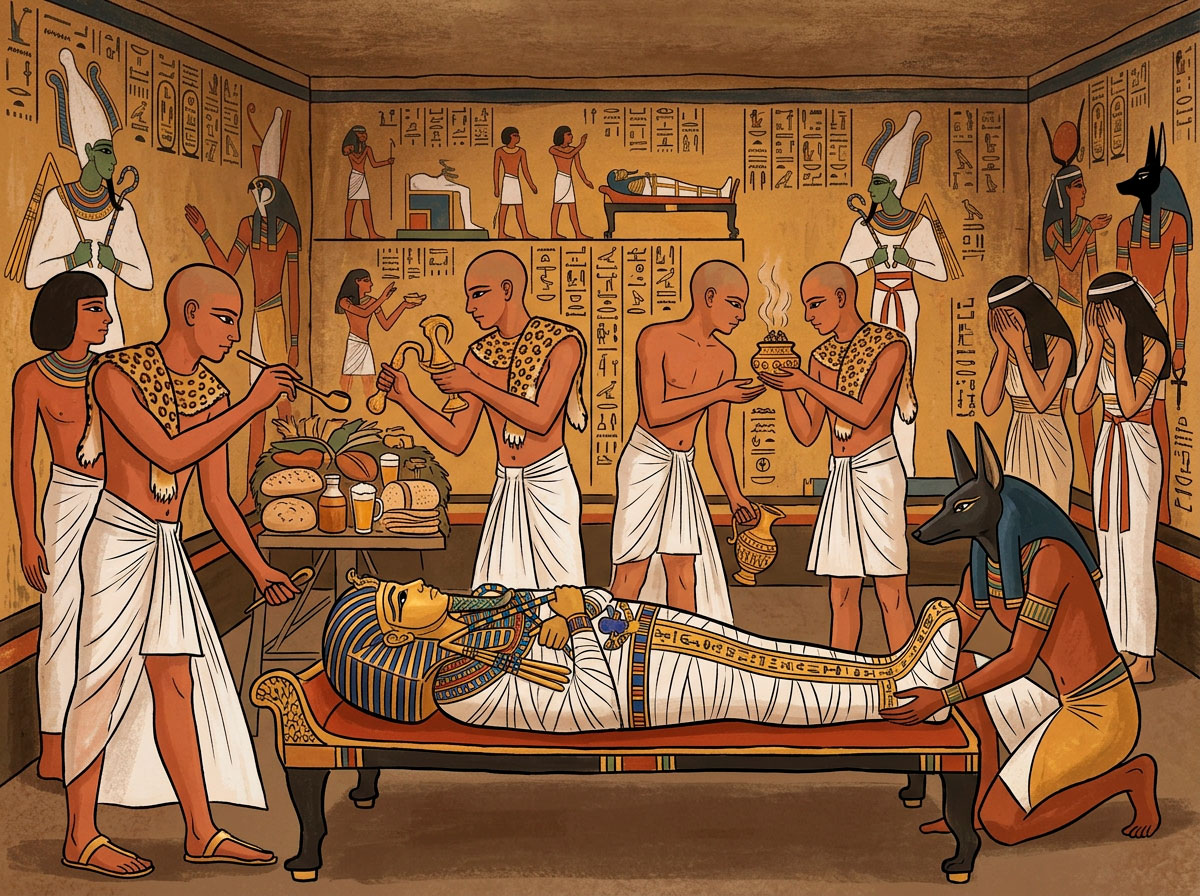
Its role in mummification was very specific: natron absorbs water from tissues and creates a very dry environment, allowing the body to be dehydrated in a controlled way. The body, already eviscerated, was completely covered in natron for about 40 days. This wasn't magic preserving the flesh: it was a drying mineral doing, on the scale of an entire body, something similar to what salt does when used to preserve food.

The very name of sodium as a chemical element, natrium, comes from natron. It's another trace of how Egyptian mineralogy made its way, centuries later, into modern scientific vocabulary — just as happened with the word "chemistry."
Minerals in Ancient Egypt Cristalljoia

Stone: alabaster, granite and the architecture that survived time

What was called "alabaster" in Egypt is not the soft gypsum we associate with that name in Europe today, but a variety of calcite — the same mineral, in a different structure, that forms stalactites in a cave. Its semi-transparency and ease of carving made it the stone of choice for canopic jars, like those found in Tutankhamun's tomb, and for complete sarcophagi carved from a single block.

What are canopic jars? These were ritual containers, usually carved in stone, used to preserve separately the internal organs removed from the body during mummification — liver, lungs, stomach and intestines. The heart, by contrast, was usually left inside the body because of its symbolic importance. Each jar was protected by a different deity, and they were typically grouped together in a chest next to the sarcophagus.

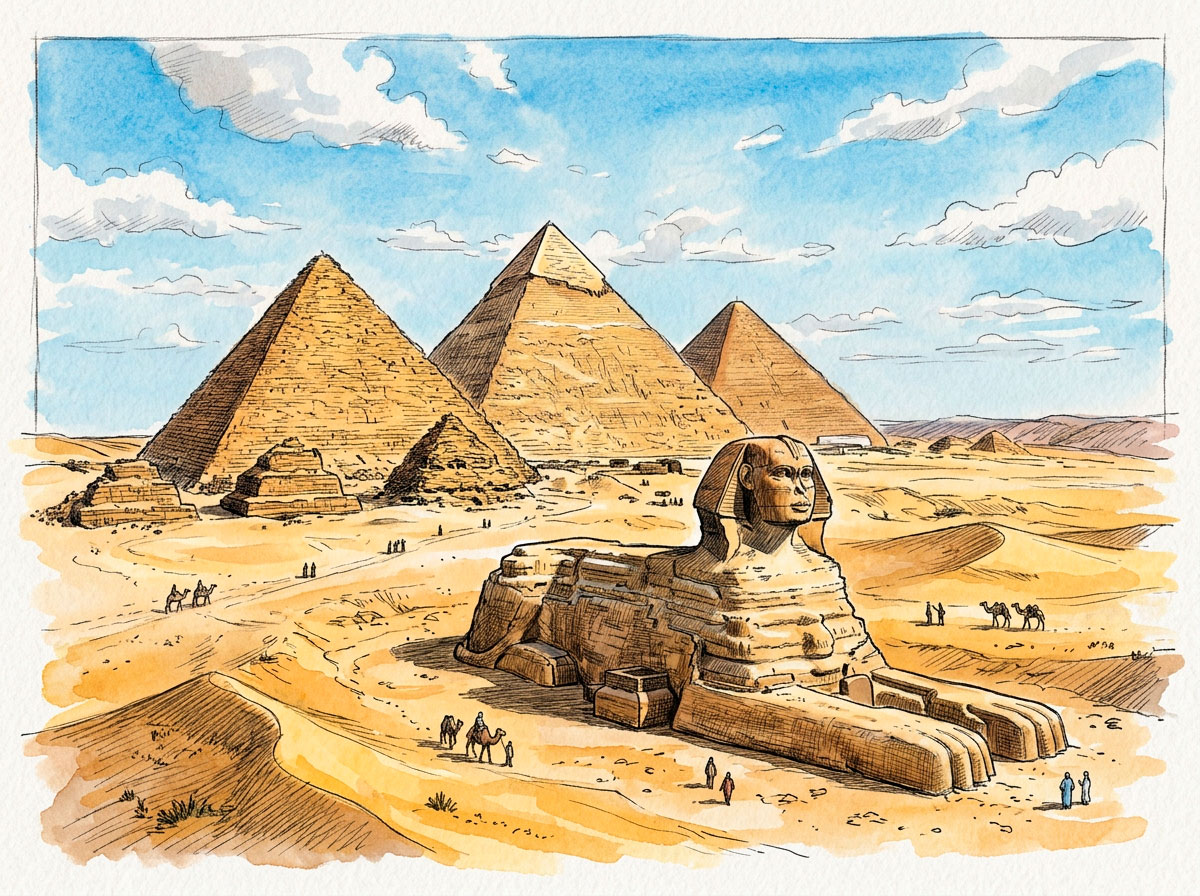
On a larger scale, Egypt's monumental architecture relied on limestone for massive building blocks — the pyramids of Giza are, for the most part, local limestone — and on granite, far harder and more resistant, for elements meant to endure: obelisks, royal sarcophagi and the lining of funerary chambers. This was not an aesthetic choice: it was materials engineering applied with the available geological resources.

Minerals in Ancient Egypt Cristalljoia

Trade: minerals Egypt didn't have but needed all the same

Not every mineral essential to Egypt was found in Egypt. Lapis lazuli, present in Tutankhamun's funerary mask and in formulas from the Ebers Papyrus, came entirely from the mines of Sar-e-Sang, in present-day Afghanistan, more than 4,000 kilometers away. Turquoise was mined in the Sinai Peninsula, through mining expeditions organized by the Egyptian state itself. Both cases show that demand for specific minerals — for their color, rarity or meaning — was one of the real drivers of long-distance trade in antiquity, long before that concept existed as such.

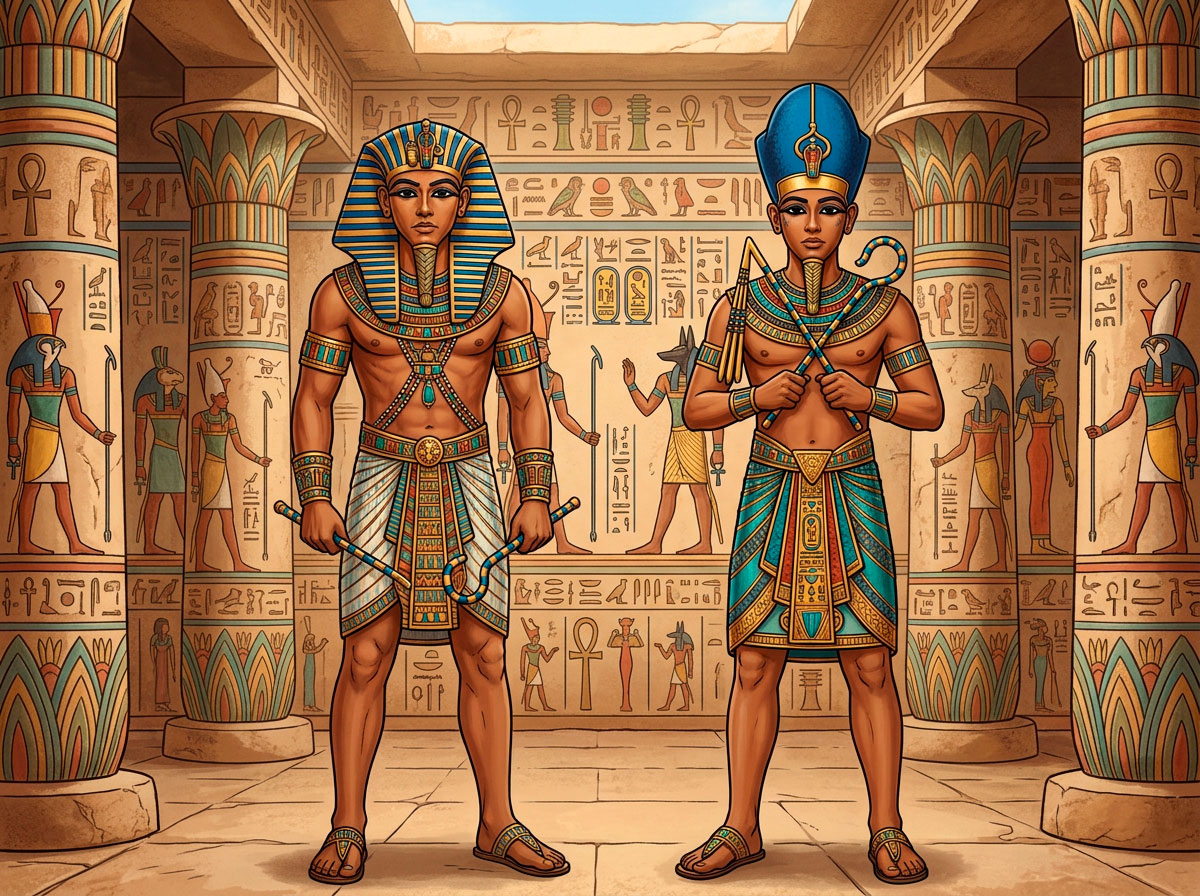
This dependency also explains the social hierarchy of colors: the blue of lapis lazuli, being imported and scarce, was almost always reserved for royalty and the most valuable ritual objects, while the green of malachite, of local origin, was far more accessible.

Minerals in Ancient Egypt Cristalljoia

What this has to do with how we look at minerals today

Egyptian mineralogy works as a mirror of something that remains true: a mineral is not only its legend, it is also its composition and physical properties. Kohl protected against the sun through its texture and color, not just by invoking a god; natron preserved a body through its ability to absorb water, not through spiritual purity. Understanding that real basis doesn't take anything away from the cultural or symbolic value of these stones — on the contrary, it explains and supports it.

It's exactly the same principle we apply today when talking about any mineral: geology first, then the meaning we decide to give it.

In summary: Ancient Egypt built much of its material culture on specific, well-known minerals: galena, malachite and lapis lazuli in kohl; natron as a drying agent in mummification, stored alongside calcite canopic jars; and lapis lazuli and turquoise imported along trade routes spanning thousands of kilometers. In every case, the choice responded to real physical properties, later wrapped in religious and symbolic language.

Frequently asked questions

What was kohl and what minerals was it made from?

Kohl was a powdered cosmetic applied around the eyes, similar to a modern eyeliner. It was made mainly with galena for black and malachite for green, along with lapis lazuli in higher-status pieces.

What is natron and what was it used for?

It is a mineral salt collected from salt lakes such as those of the Wadi El Natrun. It was used to mummify bodies because it absorbs water from tissues and dehydrates them in a controlled way. It was also used in glassmaking and cleaning.

Is Egyptian alabaster the same mineral as alabaster today?

Not exactly. Egyptian "alabaster" is a variety of calcite, while the term "alabaster" in Europe usually refers to gypsum. Both share the name because of their translucent appearance, but they are different minerals.

Where did Egypt get its lapis lazuli and turquoise?

Lapis lazuli was imported entirely from the Sar-e-Sang mines in present-day Afghanistan, via long caravan routes. Turquoise was mined through state-run mining expeditions in the Sinai Peninsula.

Looking for a specific mineral?

At our physical store in the centre of Barcelona we have many more options than what you see online.

If you can't find what you're looking for online, message me on WhatsApp at +34 670 61 16 63.

I'm Jéssica and I'll be happy to help.

visita virtual 3D
Product added to wishlist
Product added to compare.

Looking for a mineral? Write us