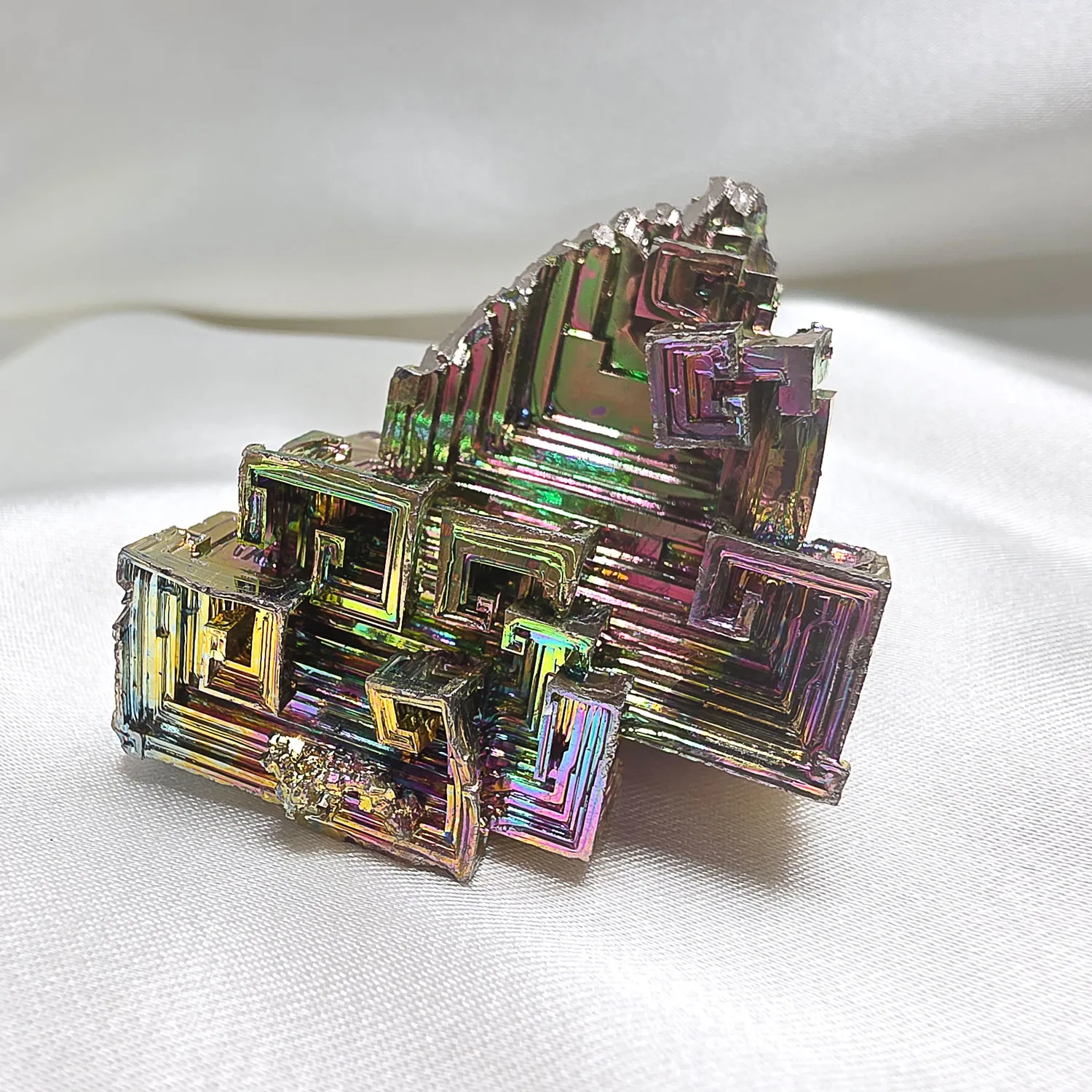
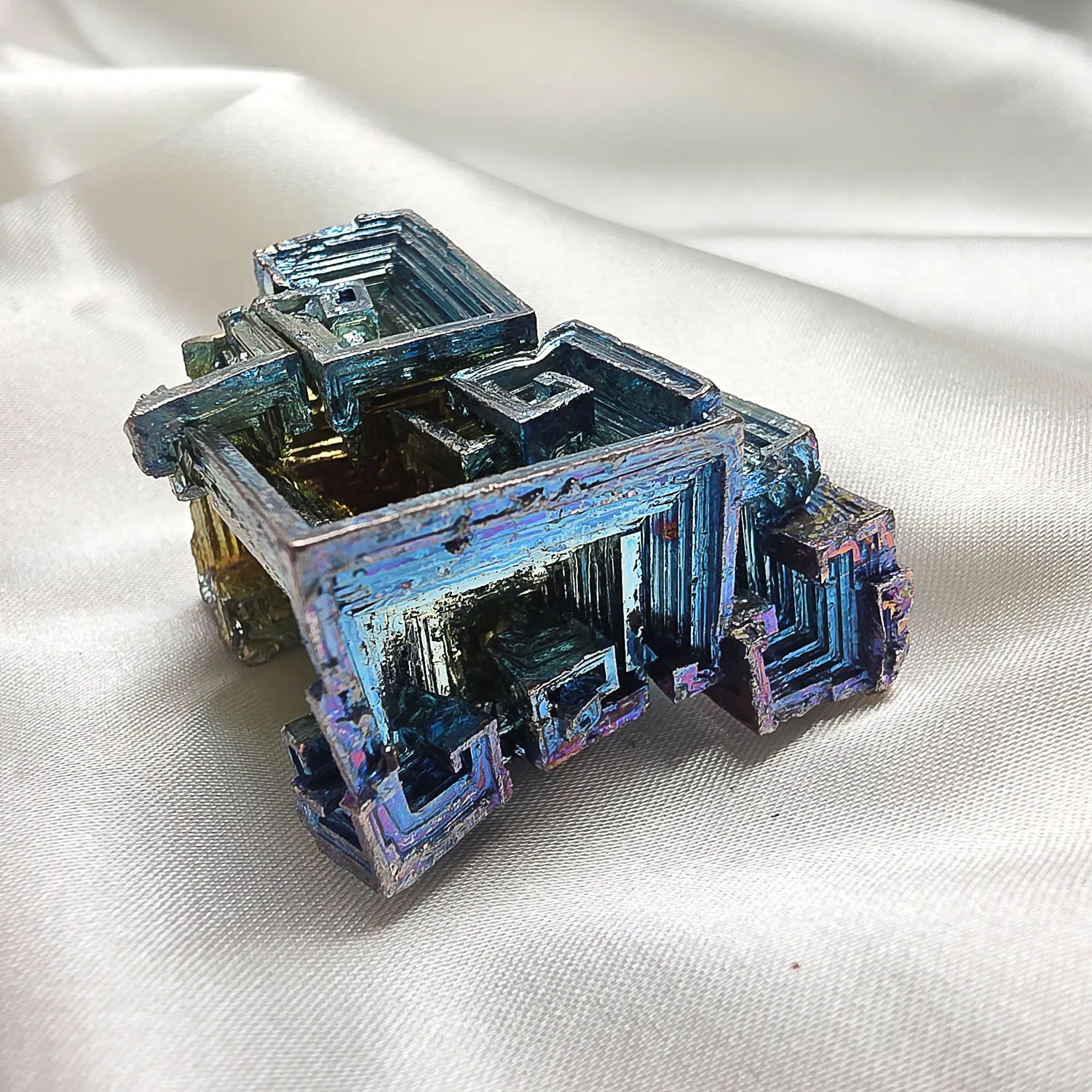
Few pieces capture attention quite like recrystallized bismuth. Its staircase-like structures, near-impossible geometry, and iridescent range of colors have turned it into a genuine sensation among collectors. But the most surprising part isn't just its appearance: unlike most collectible specimens, it isn't created by nature, but by the laboratory.
In one sentence: recrystallized bismuth is metal melted and cooled on purpose so it forms geometric crystals. It isn't a mineral found this way in nature: it's science turned into a collectible object.
What exactly is recrystallized bismuth?
Bismuth is a metallic chemical element, number 83 on the periodic table. In its natural form it's a dull, whitish-gray metal, nothing spectacular. The "recrystallized bismuth" sold as a collectible piece is high-purity bismuth that has been melted and allowed to solidify under controlled conditions, giving rise to those characteristic stepped structures.
Unlike moldavite or quartz, this isn't a geological process spanning millions of years, but a repeatable technical process: the metal is heated past its melting point (271 °C) and, as it cools, its atoms rearrange themselves into crystals visible to the naked eye.
A mineral… that isn't a mineral. Although it's sold alongside stones and minerals, recrystallized bismuth is actually an artificially crystallized pure metal. Its origin is the laboratory, though the physical phenomenon that produces it is completely real and natural.

 670-61-16-63 cmd@cristalljoia.com In the heart of Barcelona and online