Obsidian: The Volcanic Glass That Armed and Divined the Pre-Columbian World

Few stones have been as present in the daily life of a civilization as obsidian was in Mesoamerica —the cultural region that stretches, broadly speaking, from central Mexico to Costa Rica, homeland of the Aztecs, Maya, Olmecs and other pre-Columbian peoples—. It wasn't just a shiny black stone.

It was used to cut, to hunt, to wage war and to shave. And, according to its craftsmen, it could also be used to glimpse fate itself.

In a nutshell: obsidian is a volcanic glass formed when silica-rich lava cools so quickly that no crystals have time to form, and which Mesoamerican cultures turned into their most versatile material: tool, weapon, ritual mirror and status object, all at once.

A Stone That's Actually Glass

Mineralogically speaking, obsidian isn't a mineral: it's a natural glass. Its atoms never manage to organize into a crystalline structure, because the lava cools far too quickly.

That's why it breaks with conchoidal, curved fractures, like a seashell. And that's why, when knapped, it produces an edge just a few atoms thick: sharper than many steel scalpel blades. Some surgeons still use obsidian scalpels for precision incisions.

Did you know…? Obsidian's color depends on its composition: small amounts of iron oxide and magnetite, together with microscopic bubbles and inclusions, produce the classic black, gray, mahogany, or the greenish and bluish sheens so prized by pre-Hispanic artisans.

Obsidian at Cristalljoia Barcelona

The Material That Helped Define Mesoamerica

Obsidian working was so widespread and specialized that anthropologist Paul Kirchhoff used it as one of the traits defining "Mesoamerica" as a cultural area.

From the Olmecs to the Mexica, through the Teotihuacanos, Toltecs and Maya, almost no society in the region did without it. Every splinter was put to use: from everyday household knives to elite jewelry.

Fun fact: although obsidian is volcanic in origin, it doesn't form near just any volcano. It requires silica-rich (acidic) lavas, so its deposits are relatively scarce and highly localized, which made it a long-distance trade good long before Europeans arrived.

Sierra de las Navajas: The Green Obsidian Deposit

Of all the Mesoamerican deposits, one became legendary: Sierra de las Navajas, in Hidalgo (Mexico), the only known source of green obsidian in the entire region.

Its exploitation, begun by Teotihuacan and continued by the Toltecs and Mexica, required genuine underground mining, not just surface collection. Alongside Otumba, with its gray-black obsidian, it supplied workshops hundreds of kilometers away.

  • Gray-black obsidian: the most abundant, used mainly for everyday tools and weapons.
  • Green obsidian from Sierra de las Navajas: scarce and highly prized, associated with status objects and the Teotihuacan, Toltec and Mexica elites.
  • Mahogany, golden or "rainbow" obsidian: rarer varieties, almost always reserved for ritual or ornamental pieces.
Obsidian at Cristalljoia Barcelona

Tools, Blades... and a Sword That Terrified the Conquistadors

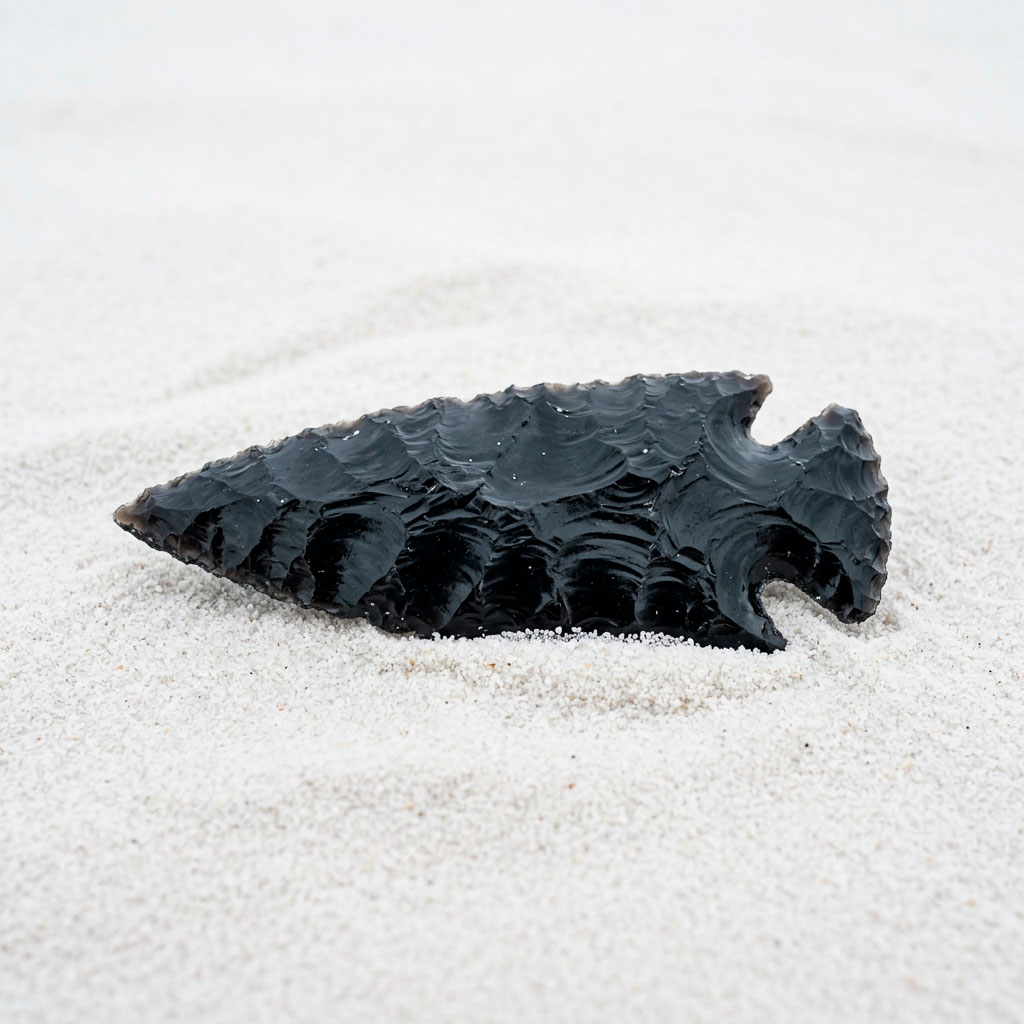
The edge was obtained through knapping, striking the core with stone or bone hammerstones to detach flakes and prismatic blades.

This technique produced blades and knives sharp enough for daily domestic tasks: cutting, scraping hides, preparing food. Also specialized scrapers for working the maguey plant to extract pulque, plus arrowheads and spearheads for hunting.

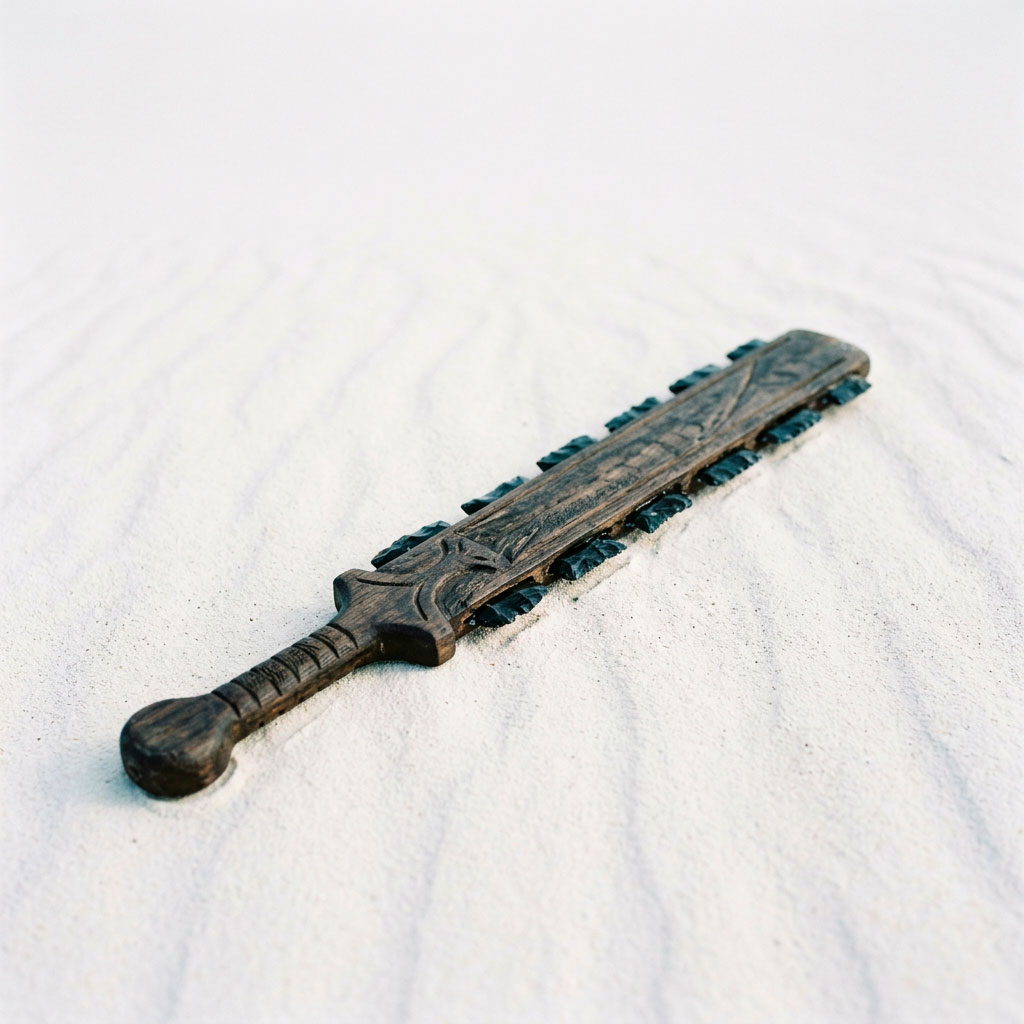
On the battlefield, the star piece was the macuahuitl: a wooden club with rows of obsidian blades set into its sides, the most iconic weapon in the Mexica arsenal.

Obsidian also played a very direct religious role, not merely a symbolic one: it was used to make sacrificial knives and the blades used in ritual autosacrifice, where priests and rulers pierced themselves to offer their own blood to the gods.

And, patiently polished, it was used for adornments reserved for warriors, priests and rulers: ear ornaments, necklaces, lip plugs, beads and ritual masks, plus the famous decorative inlays in jewelry and sculptures.

Fun fact: the macuahuitl wasn't designed to pierce through like a steel sword, but to cut and tear; its modular design allowed broken obsidian blades to be replaced between battles, quite advanced for a weapon with no metal.

Smoking Mirrors: When Obsidian Looked Into the Spiritual World

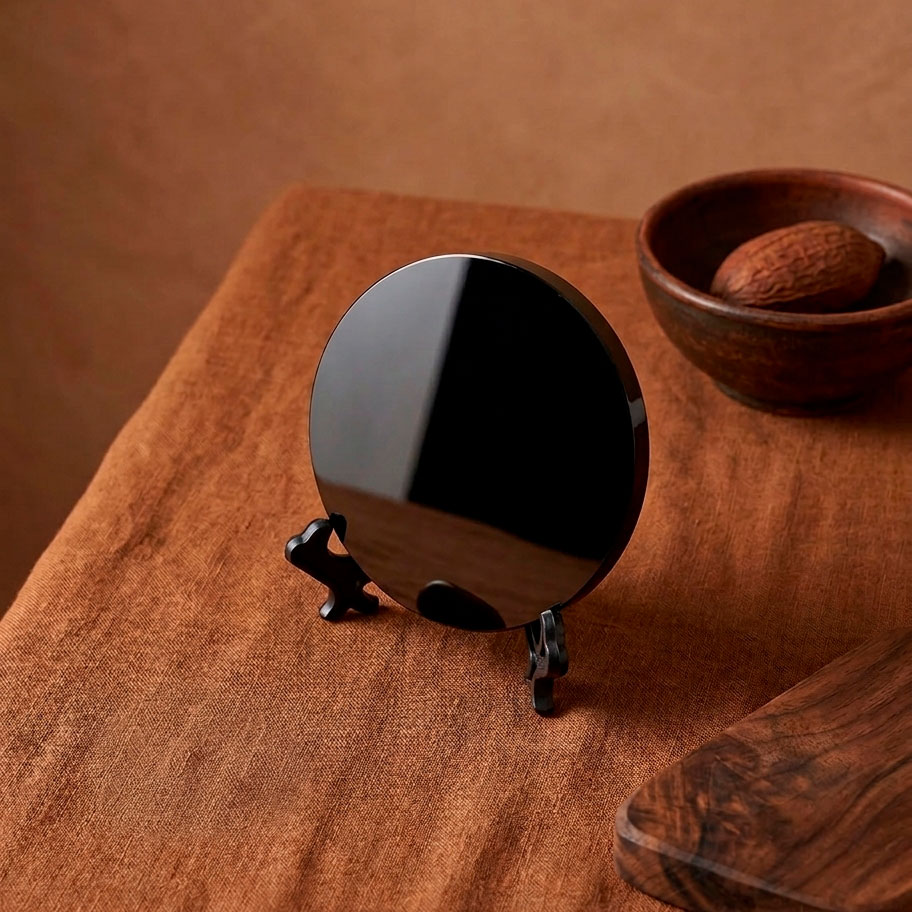
Polished to a shine, obsidian became a mirror. These held a central place in Mexica cosmology, associated with Tezcatlipoca, "Smoking Mirror," one of the most important deities in the Aztec pantheon.

According to the codices, priests and rulers used them in divination rituals and as a symbol of power. Today barely a dozen and a half pre-Columbian examples survive in museums worldwide.

Did you know…? One of those Aztec obsidian mirrors, now in the British Museum, belonged to Elizabethan mathematician and astrologer John Dee, who used it in London, in the 16th century, for his own "scrying" sessions —a curious bridge between pre-Hispanic Mexico and the England of Queen Elizabeth I.

Obsidian at Cristalljoia Barcelona

Looking for a specific mineral?

At our physical store in the centre of Barcelona we have many more options than what you see online.

If you can't find what you're looking for online, message me on WhatsApp at +34 670 61 16 63.

I'm Jéssica and I'll be happy to help.

visita virtual 3D
Product added to wishlist
Product added to compare.

Looking for a mineral? Write us