Types of tourmaline: the mineral that comes in every color

If there is one mineral that challenges the idea that "every stone has its color," it is tourmaline. Pink, green, black, electric blue, bicolor... all within the same mineral group. How is that possible? Because tourmaline is not a single species: it is a family of minerals that share the same crystal structure but have different chemical compositions. The elements they share are silicon, aluminum, and boron; what changes is the mix of other elements: sodium, lithium, calcium, magnesium, manganese, iron, chromium, vanadium, fluorine, and sometimes copper. Change the element, change the color.

Did you know? The International Mineralogical Association recognizes 33 mineral species within the tourmaline group. Their crystals always have a rounded triangular cross-section with longitudinal striations, which distinguishes them from quartz, which has a hexagonal cross-section.
Tourmaline in a wide variety of colors at Cristalljoia Barcelona

Elbaite — the most versatile

Elbaite is the most common gem-quality tourmaline species and the one with the greatest color variety. Its name comes from the island of Elba, in Italy, where the first documented specimens were found. Within elbaite there are several named varieties:

Elbaite varieties

  • Rubellite — the red or intense pink variety. One of the most valued in jewelry.
  • Indicolite — blue, ranging from light blue to deep blue-green.
  • Verdelite — green, in a range from light to intense.
  • Achroite — colorless, the rarest variety within elbaite.
  • Siberite — violet or purple, originally found in the Urals.
  • Watermelon tourmaline — bicolor pink and green, typically with a pink core surrounded by a green outer layer, sometimes separated by a colorless band. Cross-section slices, which reveal the cut like a real watermelon, are highly sought after by collectors.
Curiosity: Watermelon tourmaline is not made by joining two stones. It is a single crystal that changed chemical composition during growth: first it grew with more lithium (pink), then the geological fluid shifted and added more iron (green). Nature as artist.
Tourmaline in a wide variety of colors at Cristalljoia Barcelona

Pink tourmaline — the most delicate

Pink tourmaline is a variety of elbaite whose color ranges from pale pink, almost colorless, to intense fuchsia. The tone is determined by manganese: the higher the concentration, the greater the saturation. It is one of the most popular varieties in jewelry, especially in combination with silver or white gold. It is often confused with rubellite, but the distinction matters: rubellite refers specifically to intense red or highly saturated pink; softer pinks are simply called pink tourmaline.

Pink vs. rubellite: The distinction is not just aesthetic. Rubellite must maintain its red or intense pink color under both natural and artificial light. If the stone shifts toward brown or loses saturation under incandescent light, it is classified as pink tourmaline, not rubellite. A criterion that directly affects price.

Blue tourmaline (indicolite) — the rarest of the cool spectrum

Indicolite is the blue variety of elbaite. Its color range goes from pale sky blue to deep blue-green, almost teal. The color is produced by iron in combination with other elements, and intensity varies greatly from one specimen to another. Pure blue and saturated blue-green tones are the most valued; darker stones that lose luminosity drop in price. Brazil and Nigeria are its main sources.

Indicolite vs. Paraíba: Both are blue, but they have nothing in common mineralogically. Indicolite owes its color to iron; Paraíba owes it to copper. The visual result can look similar in tone, but Paraíba has a neon luminosity that indicolite cannot match. And a price difference that can be ten to one.
Tourmaline in a wide variety of colors at Cristalljoia Barcelona

Green tourmaline (verdelite) — the closest to emerald

Verdelite is the green variety of elbaite, and its range of tones is broad: from soft mint green to deep forest green. The color is produced by iron, sometimes in combination with titanium or manganese. The most saturated and clean green specimens are the most valued, especially those that in photographs resemble an emerald but without the inclusions characteristic of that stone. Brazil, particularly Minas Gerais, is the most recognized source.

Verdelite vs. emerald: At equal color, verdelite tends to have fewer internal inclusions and greater transparency than emerald. Emerald has a color gemologists call "emerald green" — with a very specific blue tint produced by chromium — that verdelite rarely matches. But in mid-quality stones, the visual difference to the untrained eye can be minimal.

Dravite — the brown variety

Dravite is a distinct species within the tourmaline group, rich in magnesium and sodium. Its tones range from golden yellow to deep brown, passing through reddish brown. The name comes from the Drava region in Slovenia, where it was first described. It is the least glamorous commercially, but mineralogically very interesting: it forms well-developed prismatic crystals and appears in geological settings different from those of elbaite, frequently associated with magnesium-rich metamorphic rocks.

The great overlooked: Dravite rarely appears in commercial jewelry, but mineral collectors prize it when it presents transparent crystals in honey or well-saturated golden brown. Sri Lanka and Austria produce some of the finest specimens. Its price is accessible compared to other tourmalines, making it interesting for entry-level collections.
Tourmaline in a wide variety of colors at Cristalljoia Barcelona

Schorl — the most abundant

Schorl is the most common and widespread type of tourmaline in nature. It is black, opaque, and forms prismatic crystals with characteristic longitudinal striations. It rarely reaches gem quality, but well-formed crystals have real mineralogical value. It is the variety most frequently found in granites and pegmatites worldwide.

For collectors: Schorl crystals in quartz or feldspar matrix are highly prized pieces. The so-called "cockade" formations — crystals radiating outward like a fan — are particularly striking and sell well in the mineral market.

Uvite — green from chromium

Uvite is the green tourmaline that owes its color to chromium or vanadium, not iron. This makes it closely resemble an emerald in some specimens. It is less common than verdelite and highly prized when it displays saturated color.

Uvite or verdelite? Both are green, but the cause of the color is different. Verdelite (green elbaite) owes its tone to iron. Uvite owes it to chromium or vanadium — the same elements that color emeralds and rubies. That is why some uvite specimens have a much more vivid and saturated green.
Tourmaline in a wide variety of colors at Cristalljoia Barcelona

Paraíba tourmaline — the most coveted

It deserves its own chapter. Paraíba tourmalines burst onto the gemological scene in the late 1980s, when they were discovered by Brazilian miner Heitor Barbosa in a pegmatite near São José da Batalha, in the state of Paraíba. Their color — neon blue or blue-green, almost electric — had never been seen before in any tourmaline. The intensity of their tones is due to the presence of copper in the crystal structure, an unusual characteristic that sets them apart from all other varieties.

In 2012, the Laboratory Manual Harmonisation Committee (LMHC) determined that all bluish and greenish tourmalines containing copper and manganese receive the Paraíba designation, regardless of geographic origin. So today the name also covers specimens from Nigeria and Mozambique. Brazil's mines were always limited in output; Mozambique established itself as a key supplier, capable of producing exceptional quality stones and even crystals of several hundred carats.

Brazil vs. Africa: Brazilian Paraíbas have a blue with a turquoise tendency and a luminosity that is hard to match. African ones (Mozambique and Nigeria) tend to be larger and can reach intense green. To the untrained eye the difference is subtle; to the gemological market, it is not: Brazilian stones command higher prices due to their historical importance and the scarcity of their mines, now nearly exhausted.
2026 update: The Swiss Gemological Institute SSEF has reported the possible discovery of a new copper-bearing tourmaline deposit in Ethiopia. Initial analyses show chemical similarities with Brazilian specimens, which could make Ethiopia an unexpected new player on the global map of this gemstone.
Tourmaline in a wide variety of colors at Cristalljoia Barcelona

Why can a single crystal have two colors?

Because the chemical composition can change during crystal growth. If the geological fluid from which the tourmaline forms shifts mid-process — more lithium here, more iron there — the crystal records that change in layers of color. A single crystal can even vary in color both longitudinally and concentrically. Watermelon tourmaline is the most famous example, but not the only one.

Technical note: Tourmaline has piezoelectric and pyroelectric properties: it generates electricity when compressed or when its temperature changes. This is the same principle behind quartz watches, and it explains why tourmaline has industrial applications well beyond jewelry.
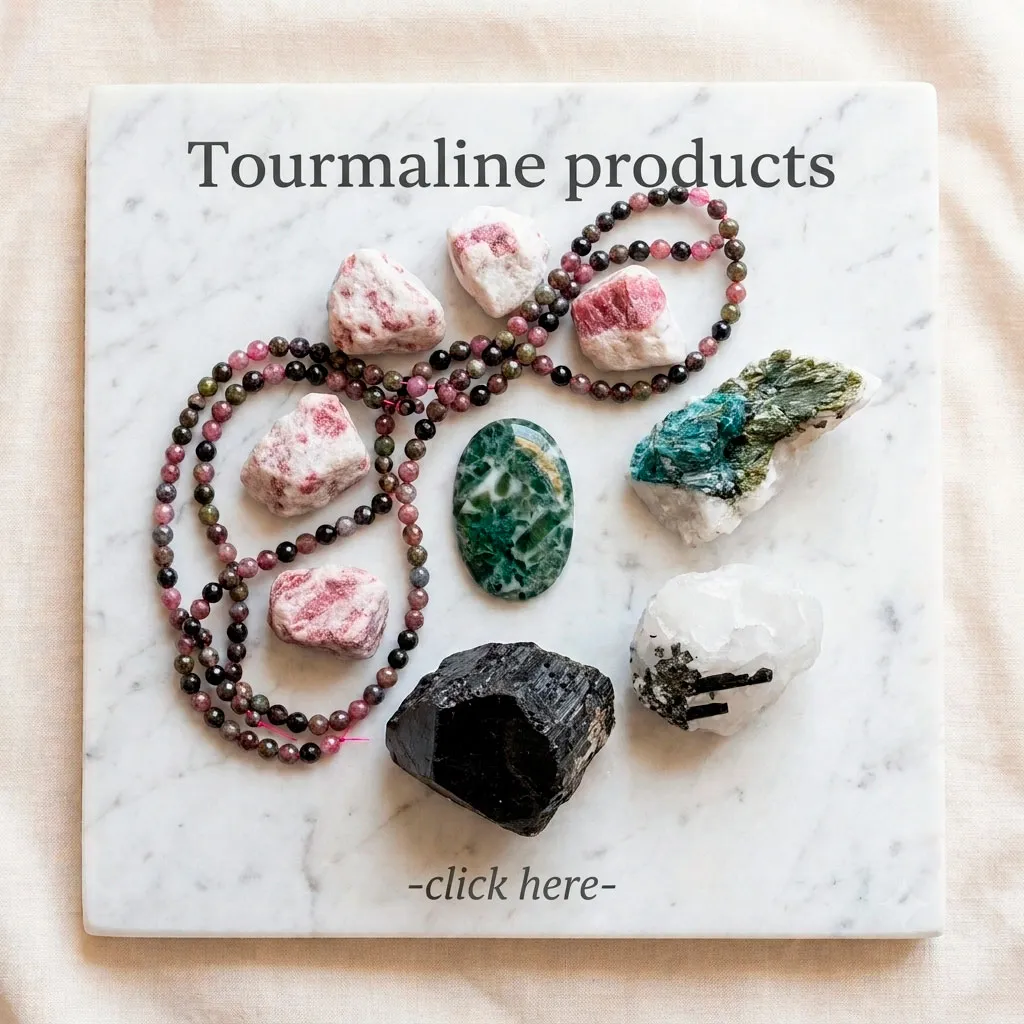
Tourmaline products at Cristalljoia Barcelona

Looking for a specific mineral?

At our physical store in the centre of Barcelona we have many more options than what you see online.

If you can't find what you're looking for online, message me on WhatsApp at +34 670 61 16 63.

I'm Jéssica and I'll be happy to help.

visita virtual 3D
Product added to wishlist
Product added to compare.

Looking for a mineral? Write us