Moon Minerals: Rocks From Another World

Few objects spark as much fascination as a fragment of rock that didn't form on Earth. A lunar mineral — whether part of a meteorite that arrived from the Moon or a sample brought back by the Apollo missions — connects with something no earthly fossil can offer: a piece of another world you can hold in your hand.

In a nutshell: lunar minerals are rocks formed billions of years ago on the Moon, which in some cases have reached Earth after being ejected into space by an asteroid impact.

A Landscape of Two Colors

If you look at the Moon on a clear night, you'll notice it isn't a single shade: there are light areas and dark areas. The light areas are the highlands, older in age; the dark areas are the lunar "seas," even though they never held a drop of water. That contrast, which ancient astronomers mistook for real oceans for centuries, is actually the first clue that the Moon has its own geology, distinct from Earth's.

Did you know…? The lunar "seas" (Mare Tranquillitatis, Mare Imbrium, Mare Serenitatis…) bear names as poetic as the Sea of Tranquility or the Sea of Rains, given by 17th-century astronomers who genuinely believed they were bodies of water.

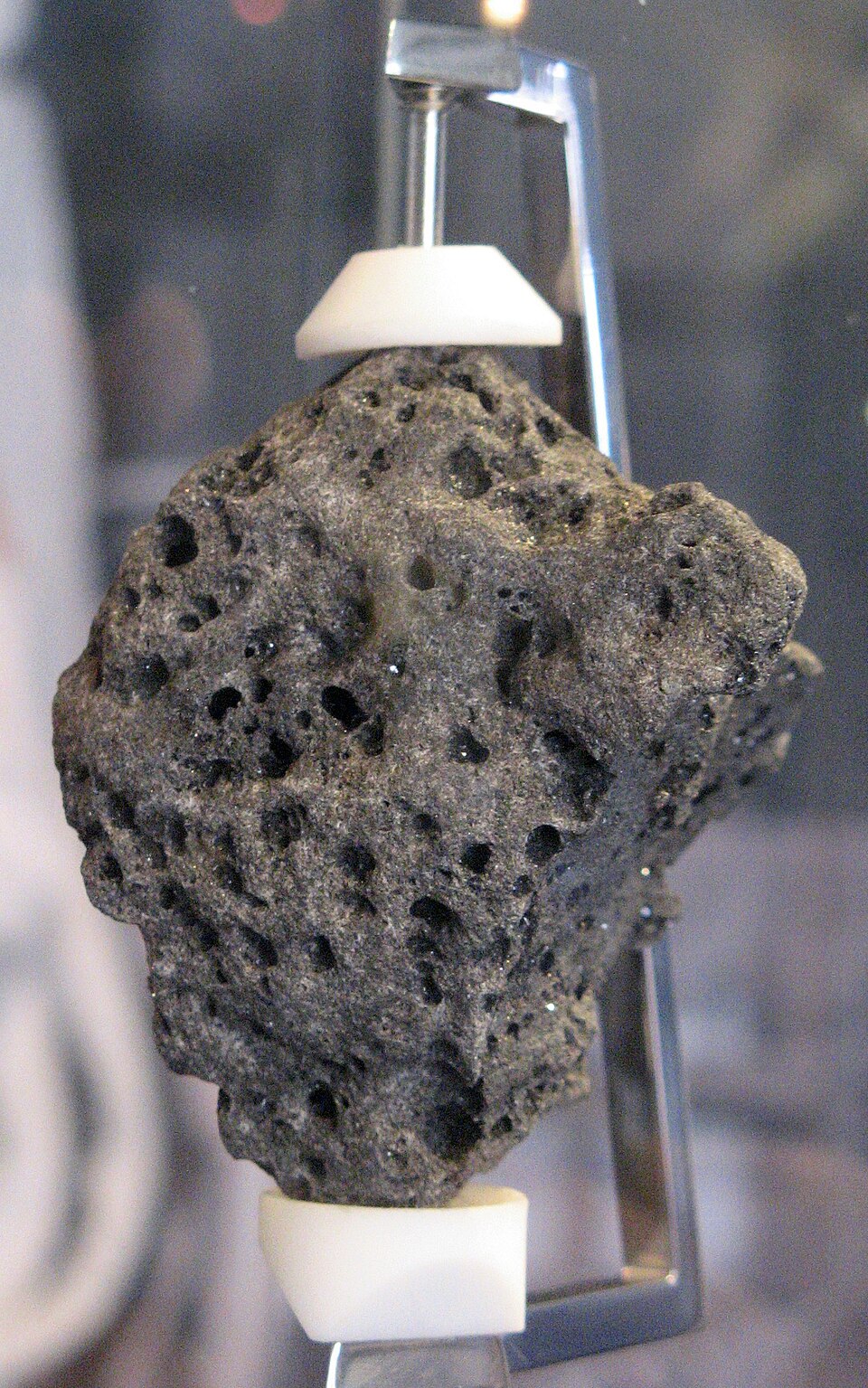
Photo 1: Display sample 10072,80 of lunar rock brought back by the Apollo 11 mission (1969). It is a vesicular basalt with intersertal texture, weighing 142.25 grams, currently on display at the Canberra Deep Space Communication Complex (Australia). Basalt is a dark volcanic rock formed when iron- and magnesium-rich lava solidifies; in this case, the "vesicular" texture indicates that it still holds small bubbles trapped by gases as the lava cooled, while "intersertal" describes how its elongated crystals are interlocked between small pockets of volcanic glass. It is, essentially, one of the most common rock types among those brought back from the lunar "seas."

Rocks Frozen in Time

On Earth, water, wind, and even plants are constantly wearing down and transforming rocks. On the Moon, none of that exists: no rain, no wind, no life. That's why many lunar rocks remain almost exactly as they were the day they formed, more than 3 billion years ago, as if time had stopped at the very moment of their birth.

Curious fact: the footprints left by Apollo astronauts in the lunar dust are still there, untouched, more than 50 years later. With no wind or rain to erase them, they could last for millions of years to come.

The Dust That Sticks to Everything

The Moon's surface is covered by a very fine layer of dust called regolith, formed over millions of years by countless small impacts that have gradually pulverized the rock. This dust is so abrasive and clings so persistently to suits and equipment that it became one of the biggest headaches of the Apollo missions: some astronauts described it as smelling like spent gunpowder when they removed their helmets inside the lunar module.

Fun fact: that lunar dust is so sharp at a microscopic level (having never been eroded) that it wore down spacesuit joints and worked its way into mechanisms, something NASA hadn't anticipated before the missions.

Photo 2: Fragment of the Northwest Africa 6950 (NWA 6950) lunar meteorite, also known as "lunaite," weighing 104 grams, part of the collection of the Maine Mineral & Gem Museum (Bethel, Maine, USA). This lunar rock was found in Algeria in 2011 and officially classified as an olivine cumulate gabbro, although that classification is somewhat imprecise: being dominated by greenish olivine, three distinct types of pyroxene, and only a minor proportion of plagioclase feldspar, it actually corresponds to a picrite rather than a true gabbro. It formed in an ancient magma chamber beneath the lunar surface, through a process of crystal accumulation as the magma cooled slowly. The dark, irregular lines running through the rock are shock veins, produced by the impact that ejected it from the Moon.

Stones That Fall From the Sky

Aside from the samples physically brought back by Apollo astronauts, almost all lunar material found outside space agency laboratories arrived by a very different path: an asteroid striking the Moon can blast out rock fragments with enough force to escape its gravity, which then, thousands or millions of years later, fall to Earth as meteorites.

  • Only a few hundred lunar meteorites have been found on Earth in total.
  • Many have turned up in deserts like the Sahara, where they're easier to spot against the sand.
  • Because of their rarity, a certified lunar meteorite can be worth, gram for gram, far more than gold.

Did you know…? The most expensive lunar meteorite ever auctioned sold for several hundred thousand dollars, despite weighing just a few grams!

The "Fire Fountain" Beads of Apollo 17

One of the most surprising discoveries of the Apollo missions was a handful of intensely orange-colored soil, almost like sand from a Martian beach, that astronauts stumbled upon in Shorty Crater. It turned out to be a remnant of ancient lunar volcanic eruptions, frozen in the form of tiny colored glass beads.

Curious moment: when astronaut Harrison Schmitt found that orange soil in 1972, he radioed back so excitedly that for a moment many people on Earth thought he'd found something truly extraordinary (and he wasn't entirely wrong).

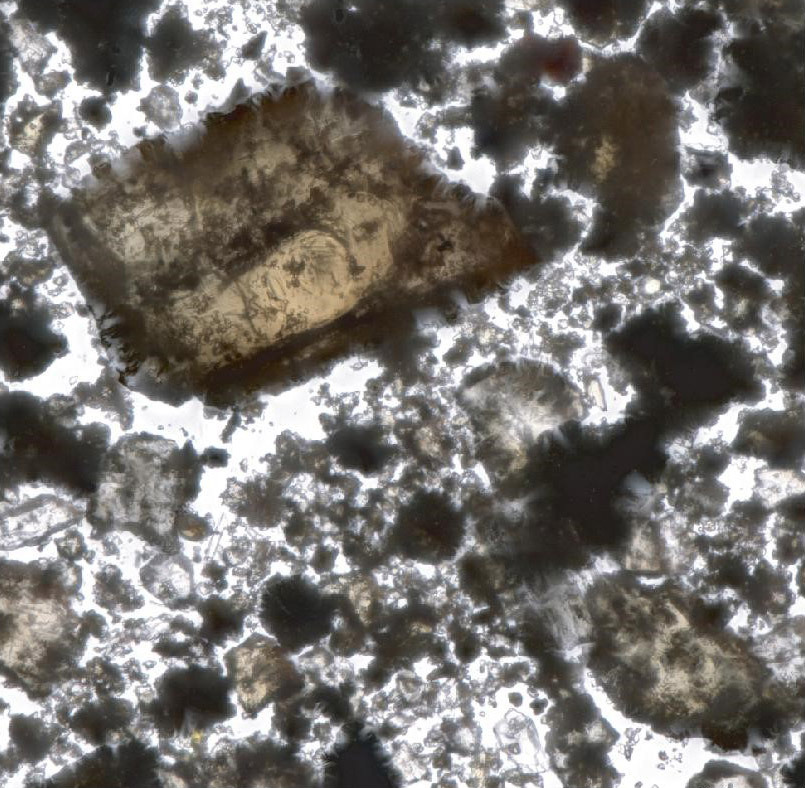
Photo 3: Stereomicroscope view of fine lunar regolith particles brought back by the Chinese Chang'e 6 mission. Regolith is the layer of dust and rock fragments covering the entire surface of the Moon, formed over billions of years by the constant impact of micrometeorites that have gradually pulverized the original rock into an extremely fine powder. Since there is no wind, water, or biological activity on the Moon to erode or transform it, this material retains many of its original characteristics intact, making it a highly valuable source of information about the satellite's geological history.

Can You Buy Moon Minerals?

Let's be clear here: the samples brought back by the Apollo missions are the property of the United States government, and their private sale or possession is illegal (in fact, there have been cases of people arrested for trying to sell stolen fragments). What does circulate legally in the collectors' market are certified fragments of lunar meteorites that fell naturally to Earth, backed by independent scientific analysis.

True story: some of the small lunar rock fragments NASA gave away as "goodwill" gifts to different countries in the 1970s ended up lost, stolen, or misplaced in government storage, and today they're sought after as genuine treasures.

Typical Moon Minerals and Rocks

Although every lunar sample is unique, a handful of "classics" show up again and again in rocks brought back by the Apollo missions and in lunar meteorites:

  • Anorthosite: the light-colored rock that makes up much of the highlands.
  • Lunar basalt: the dark rock filling the "seas," similar to terrestrial basalt but with more iron and titanium.
  • Pyroxene and olivine: greenish, dark minerals also very common in volcanic rocks on Earth.
  • Ilmenite: an iron-titanium mineral especially abundant in the lunar seas.
  • Volcanic glass: tiny colored beads, like the famous "orange beads" from Apollo 17.
  • Lunar breccia: a kind of "mosaic" of different rock fragments, welded together by ancient impacts.

Minerals Once Thought to Exist Only on the Moon

  • Armalcolite: discovered in Apollo 11 samples and named by combining the surnames of the mission's three astronauts (ARMstrong, ALdrin, COLlins). For years it was believed to be exclusive to the Moon, until minute traces were also found on Earth.
  • Tranquillityite: named after the Sea of Tranquility, where it was first found. It was considered a 100% lunar mineral for more than forty years, until in 2011 it was also discovered in rocks from Western Australia.

Both cases are a good reminder that in geology, "exclusive" sometimes just means "we haven't found it anywhere else yet."

Frequently Asked Questions About Moon Minerals

What are the dark and light areas of the Moon made of?

  • The light areas are the highlands, older in age and grayish in tone.
  • The dark areas are the lunar "seas," even though they never held water.
  • That contrast is what makes the "face" of the Moon visible to the naked eye.

How does a piece of the Moon reach Earth?

  • An asteroid strikes the lunar surface and ejects fragments into space.
  • Those fragments drift for a long time, sometimes millions of years.
  • If they eventually fall to Earth, they become lunar meteorites.

Is it legal to buy a lunar meteorite?

  • Yes, as long as it's a meteorite that fell naturally, not a sample from a space mission.
  • Samples brought back by astronauts are government property and cannot be sold.
  • Always ask for a certificate confirming its lunar origin.

Why did lunar dust cause so many problems for astronauts?

  • It has never been eroded, so its particles are extremely sharp.
  • It stuck to suits, cameras, and mission instruments.
  • Some astronauts even noticed a distinctive smell when removing their helmets.

Why are lunar minerals so expensive?

  • They're extremely rare: only a few hundred are catalogued worldwide.
  • Authenticating them requires rigorous, costly scientific analysis.
  • That combination of rarity and verification drives up their collector value.

Looking for a specific mineral?

At our physical store in the centre of Barcelona we have many more options than what you see online.

If you can't find what you're looking for online, message me on WhatsApp at +34 670 61 16 63.

I'm Jéssica and I'll be happy to help.

visita virtual 3D
Product added to wishlist
Product added to compare.

Looking for a mineral? Write us