Fossilized Ammonites: The Spiral That Survived Time

Few pieces connect us to the Earth's distant past quite like a fossilized ammonite. Its perfect spiral, its mineral texture, and the fact that you're holding an animal that swam more than 100 million years ago make it one of the most sought-after fossils among collectors. But to understand why they're so special, we first need to understand what a fossil actually is.

In one sentence: a fossilized ammonite is the mineralized remains of an extinct marine mollusk, transformed into rock over millions of years while preserving the exact shape of the original animal.

What Is a Fossil?

A fossil is the remains or trace of a living being that has been preserved in rock through a process that can take thousands or millions of years. It isn't the original organism as such: in most cases, its original materials have gradually dissolved or been replaced by minerals, in a process known as mineralization or permineralization.

For this to happen, the organism must be buried quickly under sediment (sand, mud, ash), away from oxygen and from the organisms that would decompose it. Over time, mineral-rich water filters through those remains and gradually replaces the original material, atom by atom, with minerals such as calcite, silica, or pyrite.

A mineral copy. In many fossils, not a trace of the original organic material remains: what we're holding is a rock replica, formed mineral by mineral in the very place where the animal died and was buried.

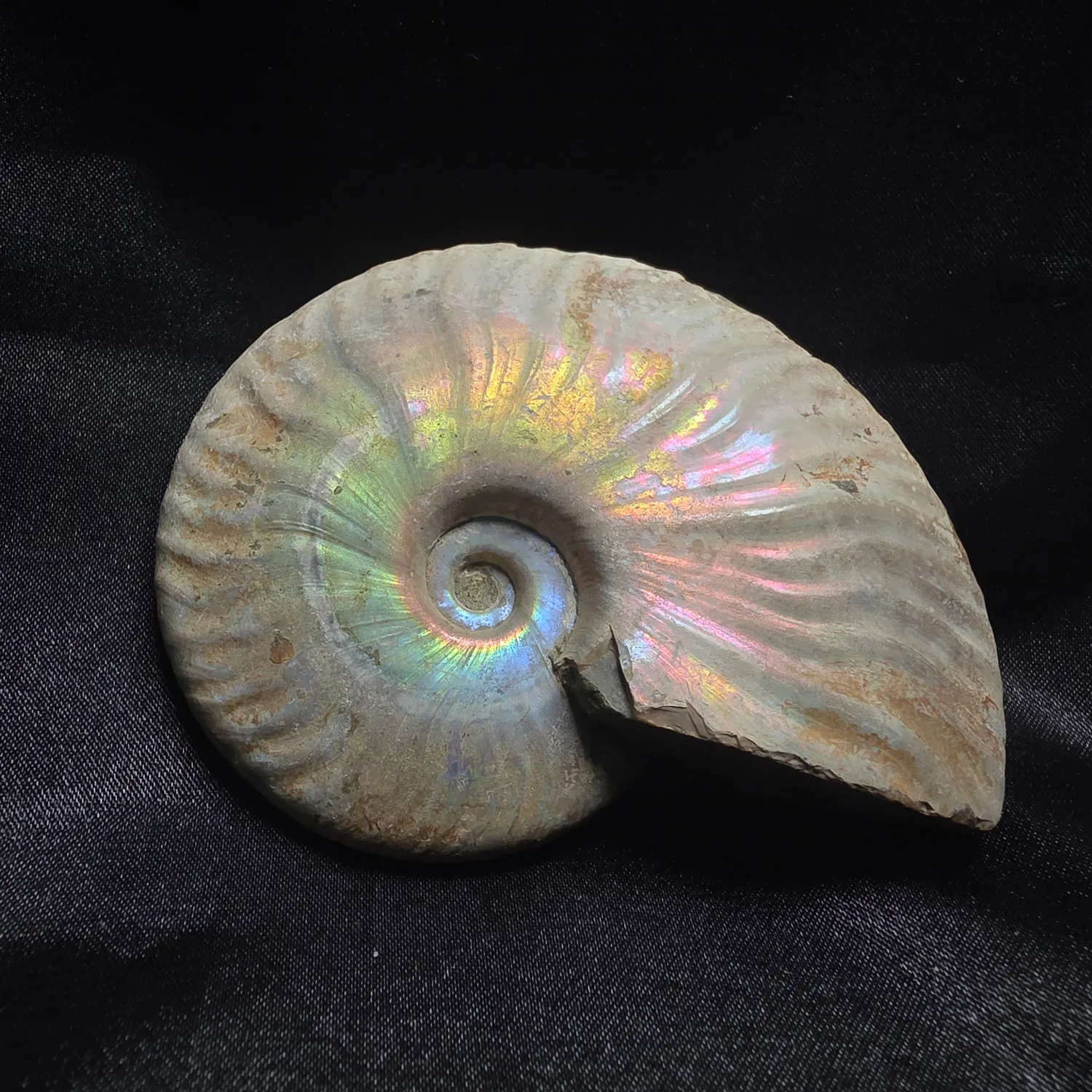
Fossil Ammonite at Cristalljoia Minerals Barcelona

What Are Fossils Good For?

Fossils are much more than curious objects: they're the main source of information we have about the history of life on Earth. Thanks to them, paleontology can reconstruct what past ecosystems were like, how species evolved, and when major extinctions occurred.

  • Dating rocks: certain fossils, called index fossils, allow precise dating of the strata where they appear.
  • Reconstructing ancient climates: the type of fossilized fauna and flora indicates whether an area was once sea, jungle, or desert.
  • Studying evolution: comparing fossils from different eras shows how species changed over time.
  • Resource exploration: geologists and energy companies use index fossils to locate oil and gas deposits.

In short, every fossil is a kind of frozen snapshot of a specific moment in the planet's history, and ammonites are one of the most reliable "cameras" we have for reading that history.

What Are Ammonites?

Ammonites were a group of marine mollusks related to today's squid and octopuses, though their closest living relative in appearance is the nautilus. They lived inside an external shell coiled in a spiral, divided into internal chambers that the animal left behind as it grew, always occupying the last and largest one.

They appeared around 400 million years ago and went extinct along with the dinosaurs about 66 million years ago, in the same mass extinction event caused by an asteroid impact. Throughout that time they populated oceans across the entire planet, ranging from species barely a centimeter across to specimens over two meters in diameter.

Biological curiosity: the name "ammonite" comes from the Egyptian god Amun, sometimes depicted with coiled ram's horns, due to the resemblance between the spiral shell and those horns.

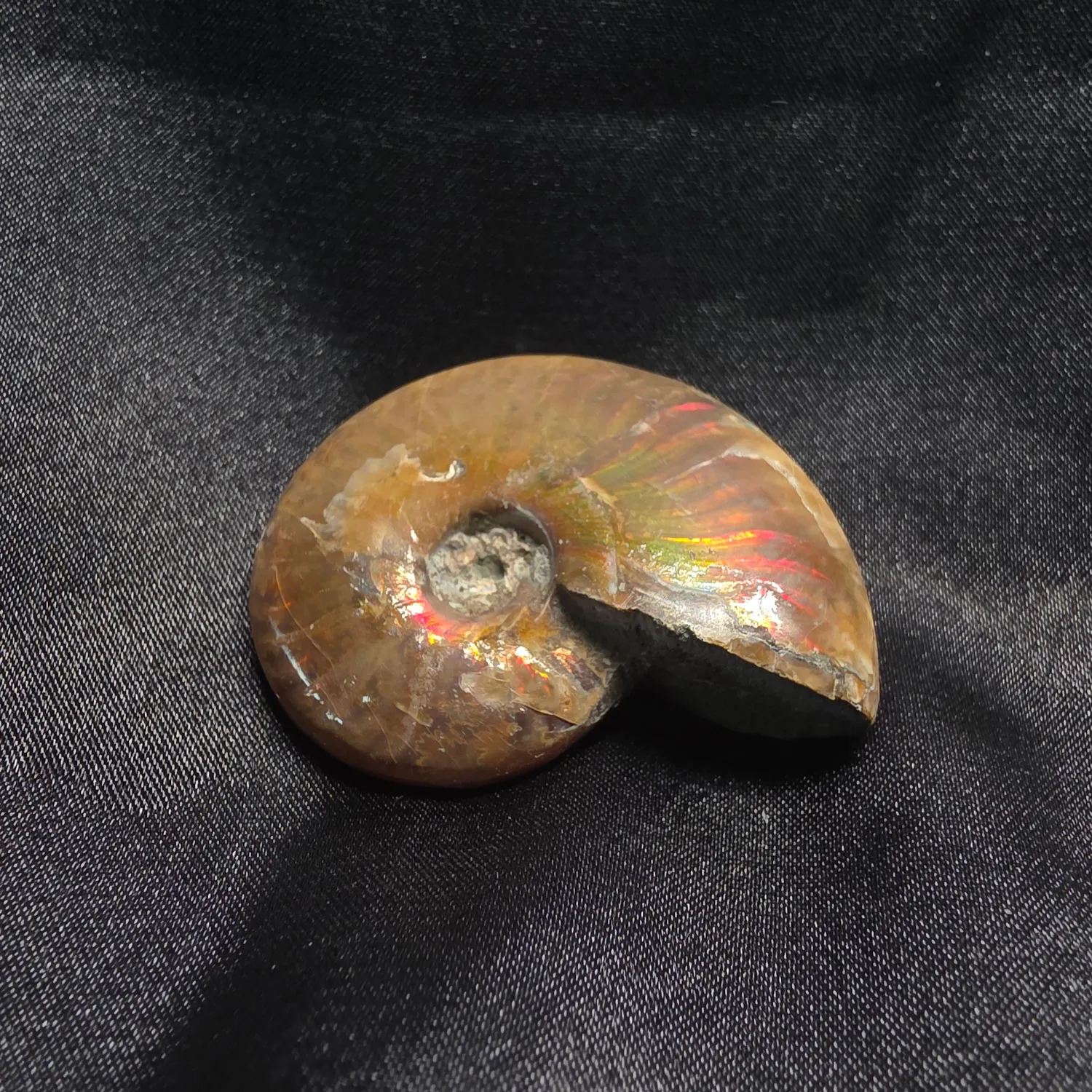
Fossil Ammonite at Cristalljoia Minerals Barcelona

Fossilized Ammonites: How a 100-Million-Year-Old Spiral Is Preserved

When an ammonite died, its shell—originally made of aragonite, a calcium carbonate mineral—could become buried on the seafloor under layers of sediment. Over millions of years, that sediment compacted into rock, and meanwhile the shell's original material gradually dissolved and was replaced by other minerals.

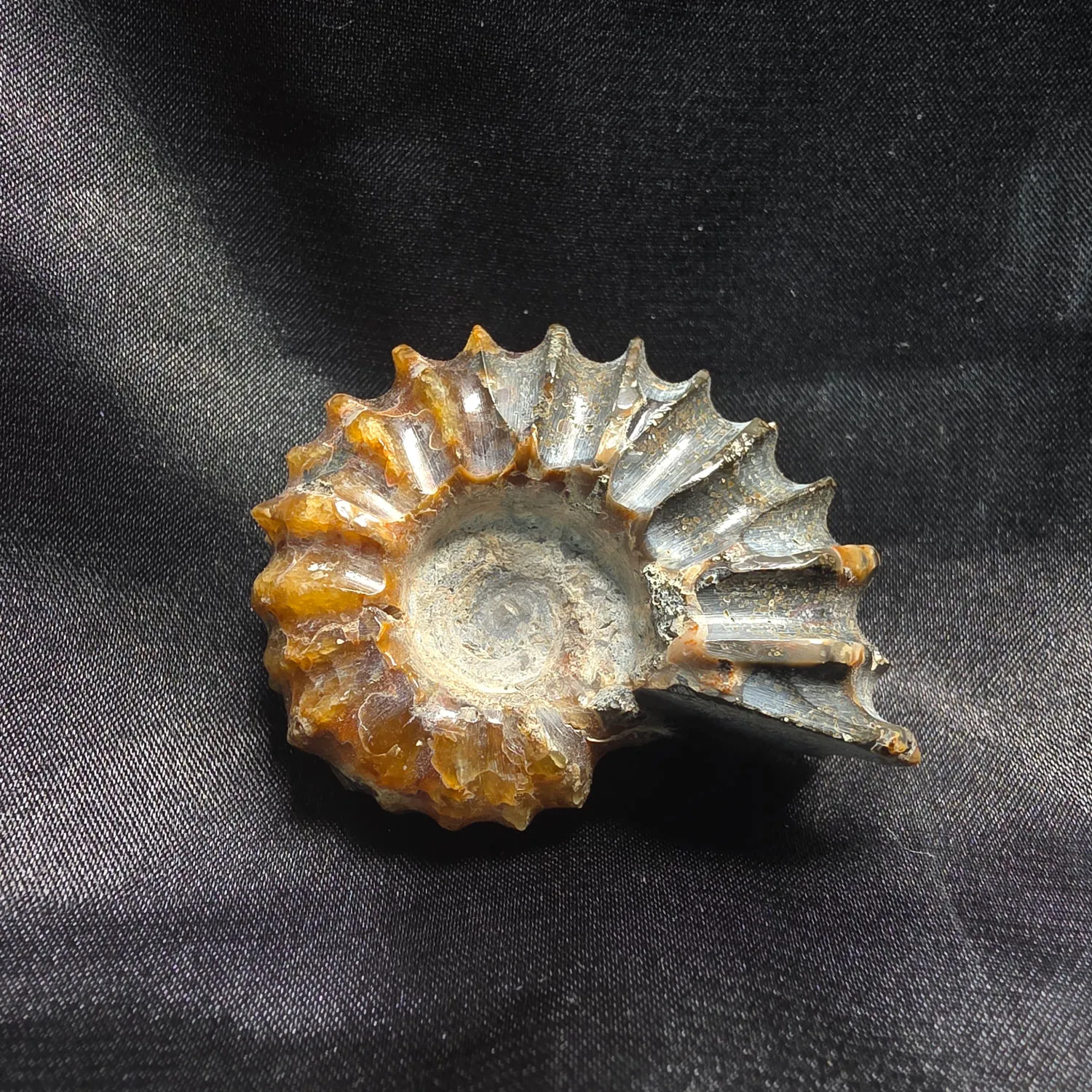
The final result depends heavily on the geological conditions of each site: some fossilized ammonites have their shell replaced by calcite or pyrite, others appear flattened inside rock nodules, and others show only a hollow mold that reproduced the animal's exact shape even though the mineral that formed it is completely different.

Did you know…? Some ammonites fossilized in pyrite shine with a golden metallic tone, since the iron sulfide completely replaced the shell's original carbonate during the fossilization process.

"Opalized" ammonites? Not really. Some ammonites display striking iridescence on the surface of the shell, with flashes of red, green, and blue. They're often called "opalized ammonites," but that name is misleading: the phenomenon has nothing to do with opal. It's caused by thin layers of aragonite and calcite that, by reflecting light at different angles, produce colors through interference—similar to what happens with mother-of-pearl. Opal is a completely different mineral (hydrated silica, with no crystalline structure) and plays no part whatsoever in this process.

Fossil Ammonite at Cristalljoia Minerals Barcelona

Ammonites from Madagascar

Much of the fossilized ammonites sold today as collector's pieces come from Madagascar, especially the Mahajanga region in the northwest of the island. There, extensive marine sedimentary rock formations from the Mesozoic era are exposed, formed when the area was covered by a shallow sea, and rich in ammonite fossils and other mollusks.

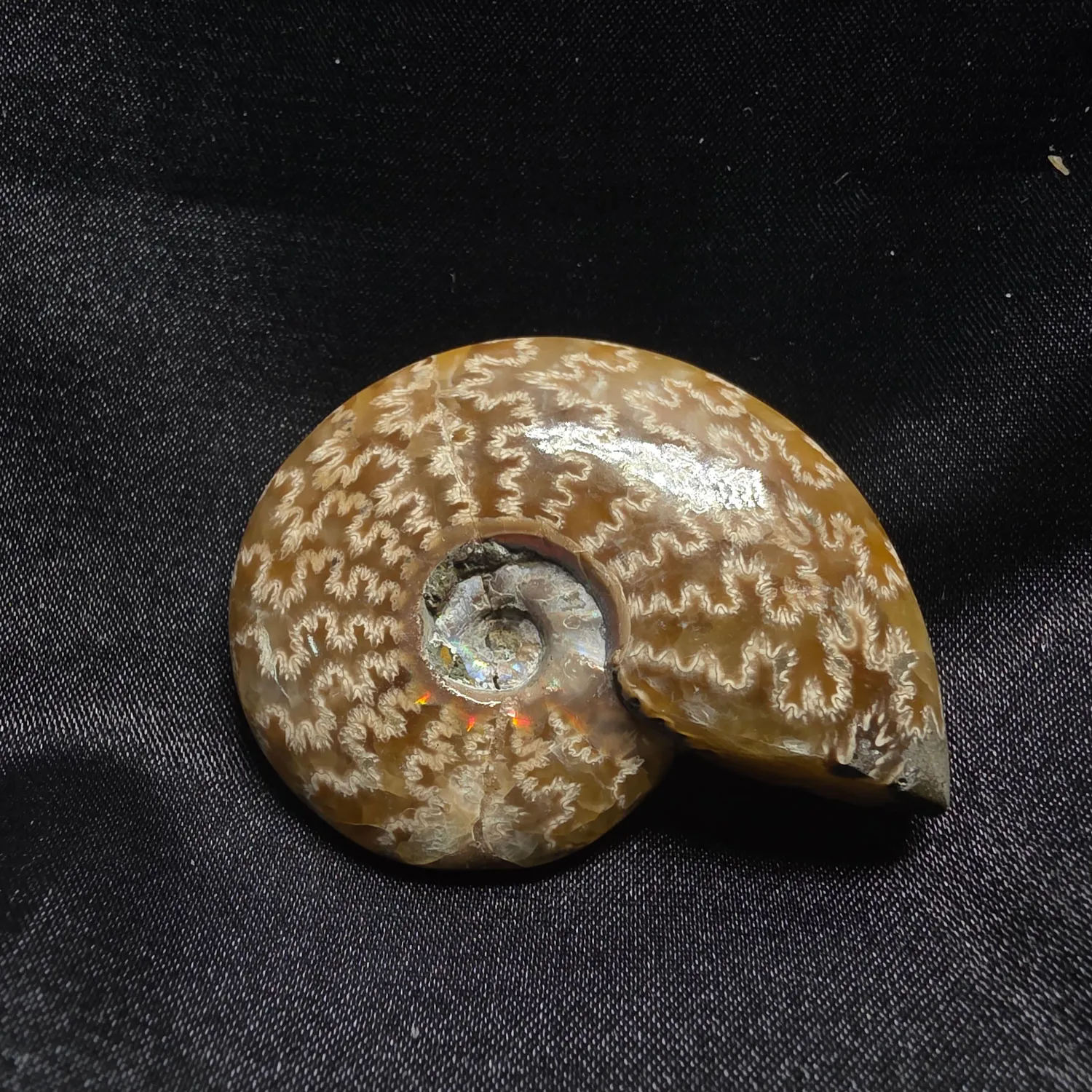
Malagasy ammonites are typically preserved with a distinctive polish that reveals their sectioned interior, showing the internal chambers separated by thin walls called septa, often with calcite crystals filling those cavities. This combination of abundant preservation, good condition, and ease of extraction has made Madagascar one of the main sources of fossilized ammonites on the market, both for collecting and for decorative use.

Fossil Ammonite at Cristalljoia Minerals Barcelona

Frequently Asked Questions About Fossilized Ammonites

What's the difference between a fossil and an ordinary rock?

  • A fossil preserves the shape of a living being, even though its mineral composition has completely changed.
  • It forms through a mineral replacement process that can take millions of years.
  • An ordinary rock lacks that biological origin and that inherited internal structure.

Are ammonites dinosaurs?

  • No, they were marine mollusks, related to squid, octopuses, and today's nautilus.
  • They lived in the sea, not on land like most dinosaurs.
  • They did share the same era and went extinct in the same event, around 66 million years ago.

What mineral are fossilized ammonites made of?

  • The original shell was made of aragonite, a calcium carbonate.
  • During fossilization it's usually replaced by calcite, pyrite, or silica, depending on the site.
  • That's why the final color and shine vary so much from one piece to another.

Why do some ammonites shine with colors like an opal?

  • It's an iridescence phenomenon caused by thin layers of aragonite and calcite, not opal.
  • Light reflects at different angles between those layers, producing colors through interference.
  • The name "opalized ammonite" is popular but mineralogically incorrect.

Why are there so many fossilized ammonites in Madagascar?

  • The island preserves extensive marine formations from the Mesozoic era.
  • Those rocks became rich in fossils from having once been under a shallow sea.
  • Their abundance and good state of preservation make extraction and trade easier.

What are fossils useful for besides collecting?

  • They help date rocks and reconstruct past climates and ecosystems.
  • They allow scientists to study how species evolved over time.
  • They're even used in applied geology, such as the search for oil and gas deposits.

Looking for a specific mineral?

At our physical store in the centre of Barcelona we have many more options than what you see online.

If you can't find what you're looking for online, message me on WhatsApp at +34 670 61 16 63.

I'm Jéssica and I'll be happy to help.

visita virtual 3D

Related products

Product added to wishlist
Product added to compare.

Looking for a mineral? Write us