Sodalite or Lapis Lazuli? The Difference Nobody Explains

Every week, people come into our shop picking up a piece of sodalite thinking it's lapis lazuli, or the other way round. And it's not their fault: both are deep blue, both are used in jewellery, and in some photos they look almost identical.

But beneath that similarity lie two completely different stories. After forty years at Cristalljoia handling and studying minerals, here is everything we know about these two fascinating blues.

The most important difference, right from the start:
  • Sodalite → it is a mineral with its own chemical formula.
  • Lapis lazuli → it is a rock, meaning a mixture of several minerals.

What exactly is each one?

Sodalite is a well-defined mineral (Na₈Al₆Si₆O₂₄Cl₂), belonging to the silicate group. It forms in alkaline igneous rocks. Its name comes from the Latin soda (sodium) + the Greek lithos (stone): literally, "sodium stone".

Lapis lazuli, on the other hand, is not a single mineral but a mixture. Some of its components are:

  • Lazurite — the mineral that gives it that deep, intense blue.
  • Calcite — forms the white veins.
  • Pyrite — the famous golden specks that glitter like stars.
? A curiosity that surprises almost everyone:

Lazurite (the blue mineral in lapis lazuli) belongs to the same mineralogical group as sodalite. They are chemical relatives, not the same species. That is why they are so easily confused, and why it is sometimes incorrectly stated that "sodalite is a component of lapis lazuli" — that is not correct.

Colour: similar but not the same

At first glance, the colour difference is the quickest clue:

  • Sodalite: royal blue with lilac tones, often crossed by prominent white veins. No metallic shimmer.
  • Lapis lazuli: deeper, more saturated ultramarine blue — almost electric in high-quality pieces. With golden pyrite flecks.
Quick rule in the shop:

Can you see golden specks or flashes? → It's lapis lazuli.
Uniform blue with prominent white veins and no metallic shimmer? → It's probably sodalite.

Origin and where they form

Sodalite is found in many parts of the world:

  • Canada (Ontario and Quebec)
  • Greenland
  • Russia, Brazil, Afghanistan

Lapis lazuli, on the other hand, has an extraordinarily concentrated geographical history:

A single place supplying the entire world:

Virtually all the lapis lazuli that has ever existed in human history has come from one single region: the Sar-i-Sang valley, in the province of Badakhshan, north-eastern Afghanistan. Those mines have been worked continuously since the Neolithic period, more than 6,000 years ago, and are still active today using methods very similar to those of prehistory.

There are smaller deposits in Chile (where the Incas also carved it), Russia and Pakistan, but Afghanistan remains the world reference.

The history of lapis lazuli: the most expensive blue in the world

This mineral has been, literally, more valuable than gold for centuries. All because of its pigment.

When lapis lazuli is ground and pure lazurite is extracted, the result is ultramarine blue — the most brilliant and stable blue pigment humanity has known until the 19th century. "Ultramarinus" in Latin means "from beyond the sea": it reached Europe from Asia travelling thousands of kilometres along dangerous trade routes.

But obtaining it was no simple matter. Simply grinding the stone produced a disappointing grey powder. Medieval craftsmen developed a process that resembled bread-making more than stonework:

  • They mixed the powder with wax, resins and oils.
  • They created a dough that was kneaded for days underwater.
  • The pure lazurite particles settled to the bottom.
  • The first "washings" yielded the highest-quality blue; subsequent ones gave increasingly muted tones.
? The blue that even Michelangelo could not afford:
  • During the Renaissance, artistic commissions specified that the client had to supply the pigment if they wanted it used in the work.
  • Michelangelo left several paintings unfinished because he could not afford it.
  • Dürer had to take on extra work to pay for a few grams.
  • Only patrons like the Medici could afford works generous in ultramarine blue.
  • The blue was reserved for the robes of the Virgin Mary — painting something blue was a declaration that it was the most important element in the picture.

Giotto used it in the frescoes of the Scrovegni Chapel in Padua. Vermeer used it in his Dutch interiors. And that blue, five hundred years later, is still just as vivid — lazurite is chemically extraordinarily stable. Synthetic ultramarine blue did not arrive until 1826.

The history of sodalite: a Welsh princess and the 20th century

Sodalite has a more understated history, but no less curious.

  • It was formally analysed by the mineralogist Thomas Thomson in 1811.
  • Its great moment came in the early 20th century, when the Princess of Wales ordered a large quantity of Canadian sodalite to decorate Marlborough House in London.
  • That commission was the starting point of its popularity in jewellery and decoration.

How to tell them apart in practice

The tips we use at Cristalljoia after decades of looking at pieces:

  • Golden specks → lapis lazuli. Sodalite has no pyrite.
  • Deeper, more saturated blue → lapis lazuli. Sodalite is more lilac-blue or royal blue.
  • Very prominent white veins → more characteristic of sodalite.
  • Ultraviolet light → sodalite fluoresces orange; lapis lazuli barely reacts.
  • Price → quality lapis lazuli is considerably more expensive.

Two blues with their own personality

Sodalite and lapis lazuli share a colour and confuse a great many people, but they have completely different natures, histories and personalities. Lapis lazuli is a rock with 6,000 years of history, which painted the skies of the Renaissance and decorated the mask of Tutankhamun. Sodalite is a mineral with its own elegance and a variety — hackmanite — that changes colour like a chameleon.

Knowing the difference not only helps you buy better: it helps you look at minerals with different eyes. And that, at Cristalljoia, is what we enjoy most.

Do you have a piece at home and you're not sure what it is? Come into the shop or write to us. We have been answering questions like this with great pleasure for forty years.

Looking for a specific mineral?

At our physical store in the centre of Barcelona we have many more options than what you see online.

If you can't find what you're looking for online, message me on WhatsApp at +34 670 61 16 63.

I'm Jéssica and I'll be happy to help.

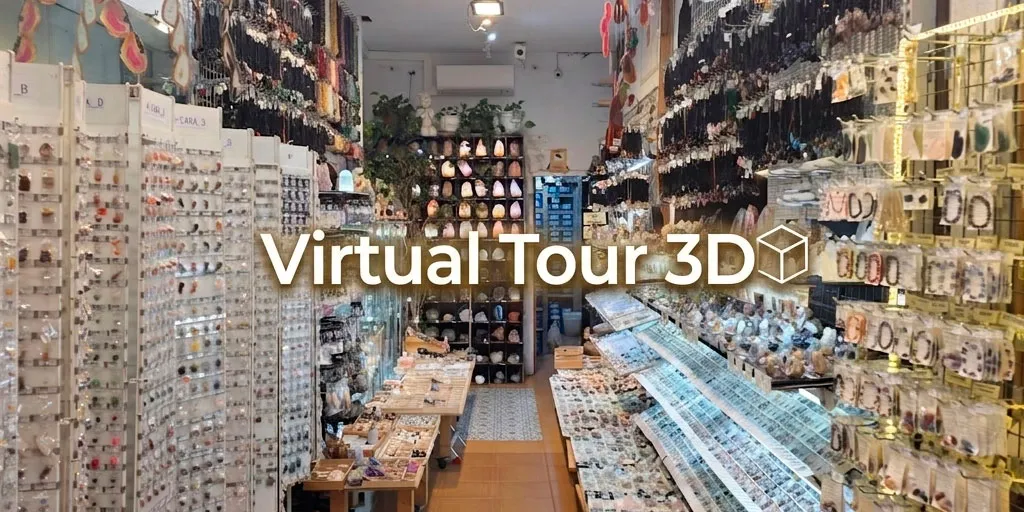
visita virtual 3D
Product added to wishlist
Product added to compare.

Looking for a mineral? Write us